Behind on US taxes for years, not months? How catch-up filing works
Years behind is fixable. Three years of returns, six years of FBARs and, if the miss was non-willful, the penalty relief that filing year by year on your own forfeits. The order the filings go in decides the outcome.
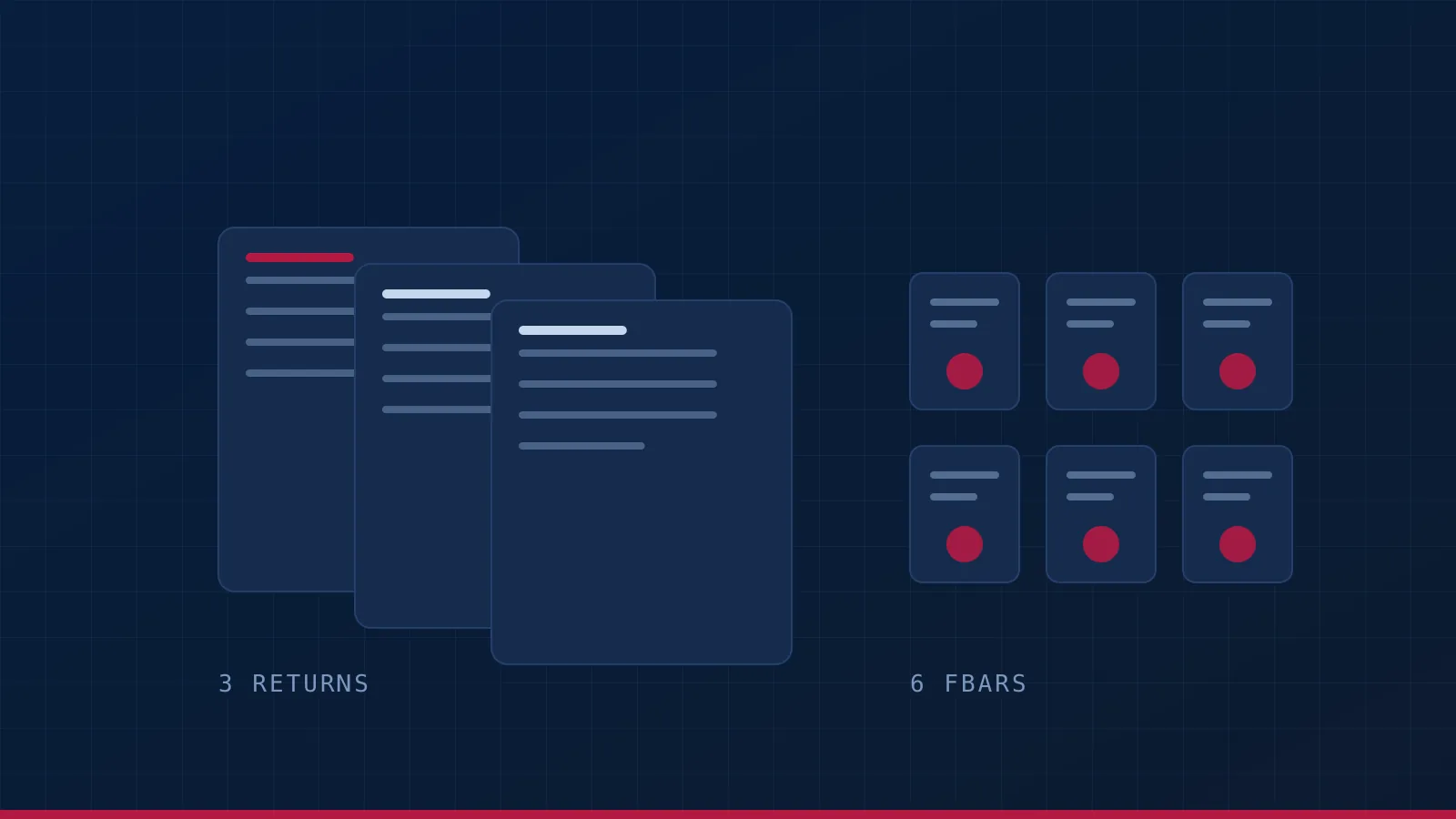

If you have lived abroad for years without filing US returns or FBARs — usually because nobody told you that the obligation follows the passport — there is a specific IRS programme for exactly that: the Streamlined Foreign Offshore Procedures. It takesthree years of delinquent returns and six years of FBARs, and for a filer whose non-filing was genuinely non-willful it carries penalty relief that filing year by year does not.
Why this is not the same as filing a few months late
Missing 15 October by weeks is a filing problem with calculable and usually modest penalties, set out in what happens if you missed the deadline.Several unfiled years is a compliance problem, and it needs a compliance solution— which is what Streamlined is: a formal programme with its own eligibility rules and its own paperwork, not a workaround.
Who qualifies
- Your tax home was outside the US for at least 330 full days in at least one of the last three years, or you meet the residence test another qualifying way.
- The failure to file was non-willful — negligence, a genuine misunderstanding of the requirement, or a good-faith mistake, rather than a decision to avoid US tax.
- You are not under IRS examination or investigation.
Non-willful is doing most of the work in that second condition, and it is worth being straight with yourself and with me about it. A large share of expats simply never learned that citizenship-based taxation means the filing obligation travels, which is the scenario the programme was written for.
What non-willful looks like in practice
Someone who moved abroad for a teaching job, assumed foreign salary was not reportable to the US and filed nothing for five years is a textbook non-willful case. Someone who was told plainly by a US preparer that a return was due and chose not to file it is a much harder case to make. If you are not sure which side of that line you sit on, that is the conversation to have before anything is submitted.
What the programme requires
- Three years of delinquent or amended federal returns — the most recent three for which the deadline has passed.
- Six years of FBARs, for each year the $10,000 aggregate threshold was met.
- A signed non-willfulness statement — Form 14653 for taxpayers abroad — setting out, in your own words, the facts behind the gap.
- Payment of the tax and interest owed for the three return years.
Done properly, a qualifying filer owes no FBAR penalty and no failure-to-file or accuracy-related penalty on the returns submitted under the programme. That relief is the entire reason to use Streamlined rather than simply filing the same returns one at a time.
Why the July 2026 FBAR change makes this more relevant
Until 1 July 2026 a taxpayer with reported income but a missing FBAR had a narrower option — the Delinquent FBAR Submission Procedures — with a published promise of no penalty. That page was removed from the IRS site without an announcement. The law did not change, but the guaranteed outcome in writing went with it. Streamlined was not affected and remains fully available, and it is now the more clearly defined route for anyone with multiple years of gaps, whether the gap is FBARs or full returns. The detail is in theFBAR deadline guide.
What it costs, and how long it takes
The Catch-Up Package is $1,395 — a published flat fee covering streamlined: 3 returns, 6 fbars, form 14653, plus next year's complete return free. It is separate from the tax itself, which depends entirely on your own figures and is frequently nothing once the exclusion is applied. Most Streamlined submissions take a few weeks from complete documents to filed; the document-gathering is the part that sets the pace.
The one mistake that forfeits the relief
Do not start filing individual back-year returns before confirming that Streamlined fits. Once a year covered by the programme has been filed in the ordinary course, outside the Streamlined submission, that year may no longer be able to travel inside it — and the penalty relief goes with it. If there is any chance you are several years behind, get the eligibility read before filing, not after.
The order of operations matters here more than almost anywhere else in expat tax.The catch-up filing service page sets out how the submission is assembled, and a free fifteen-minute call establishes whether the programme is open to you before a single back-year return is filed.
Frequently asked questions
How many years back do I need to file under Streamlined?
Three years of tax returns and six years of FBARs, counting back from the most recent year whose deadline has passed. You do not file every year you have ever missed — the programme is capped at three and six.
What if I am not sure whether my non-filing counts as non-willful?
That is the judgement to settle before anything is submitted, because the non-willfulness statement is a formal, signed part of the filing. A short conversation about the actual circumstances is usually enough to tell which side of the line you are on.
Will I owe penalties on the three years I file under Streamlined?
For a qualifying non-willful filer the programme waives the FBAR penalty and the failure-to-file and accuracy-related penalties on the returns submitted. The tax itself, and the interest on it, is still due for those years.
Can I use Streamlined if I am also missing more recent returns, like this year's?
Yes. Streamlined covers the specified back years; the current-year return is filed normally, on its usual deadline, alongside or after the Streamlined submission.
What happens if the IRS later decides I was not actually non-willful?
That is a real risk, and it is why the non-willfulness statement is not a formality. A statement that cannot be supported undoes the protection the programme is meant to give, so it is worth getting right rather than getting filed quickly.
IRS Streamlined Filing Compliance Procedures (Streamlined Foreign Offshore); Form 14653 and its instructions; 31 CFR 1010.350; IRC §911. The Catch-Up Package fee is the published $1,395 on the pricing page and covers preparation only, never the tax due. Checked 20 October 2026.
Talk to the person who signs the return.
Fifteen minutes, free, and you will know which deadline is yours and what it needs.