Can you contribute to an IRA while living abroad?
Sometimes — and less often than most people abroad assume. An IRA contribution has to come from taxable compensation, and income removed by the Foreign Earned Income Exclusion does not count as compensation. If the exclusion covers all of your earnings, you generally cannot contribute at all, and a contribution made anyway is an excess contribution, taxed at 6% a year until it is corrected.

The rule: an IRA needs taxable compensation
Living abroad does not close IRAs to you. A US citizen can contribute to a traditional or Roth IRA from anywhere, but only up to the lesser of the annual limit and the compensation earned for the year — wages, salary and self-employment income. For tax year 2026 the limit is $7,500, or $8,600 if you are 50 or older.
The catch is what counts as compensation. The IRS is explicit that amounts you exclude from income, foreign earned income and foreign housing costs among them, are not compensation for this purpose. Income the exclusion removes from your return cannot be the income that funds your IRA.
What the exclusion does to your contribution room
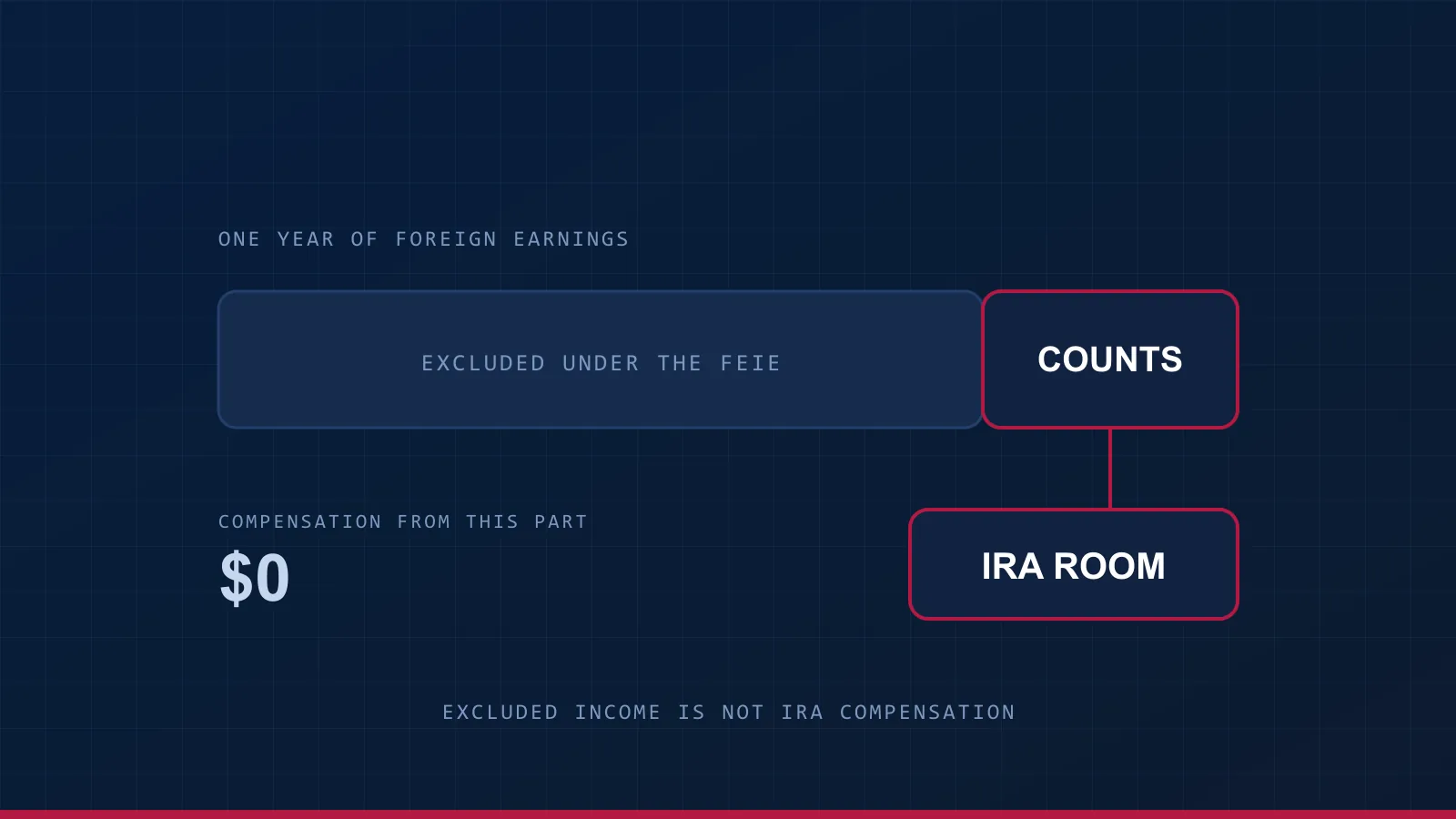
Think of your foreign earnings as one amount split in two: the part the exclusion removes, and the part left in taxable income. Only the second part is compensation. If your earnings sit entirely under the exclusion — $132,900 for tax year 2026, with the foreign housing exclusion on top — nothing is left, and your contribution room is $0. If you earn more than the exclusion, the amount above it counts, which is often enough to fund an IRA in full.
The foreign tax credit works the other way. It leaves your income in the return, so it still counts as compensation and your contribution room stays intact. That is one reason the credit often suits people who are still building retirement savings, even where the exclusion would remove more tax. Which election wins depends on your numbers, and it has to be weighed before the return is filed, because revoking the exclusion once claimed bars you from electing it again for five years without IRS consent. Whether a decision like this is worth paying for advice on is covered in do you need a US expat tax advisor?
Roth IRAs have a second test
A Roth IRA also has an income limit, measured on modified adjusted gross income. For that test the exclusion is added back, so income that cannot fund the Roth still counts against its limit. For tax year 2026, a single filer's Roth contribution phases out between $153,000 and $168,000, and a married couple filing jointly between $242,000 and $252,000.
The two rules pull in opposite directions: the exclusion shrinks the income you can contribute from, while leaving the income that tests your eligibility untouched.
If you contributed and the exclusion wiped out your income
An excess contribution is taxed at 6% for every year it stays in the account. If the exclusion leaves you with no compensation, a $7,500 contribution for tax year 2026 costs $450 for that year, and $450 again the next year if it is still there. It can usually be corrected by withdrawing the excess and the earnings on it by the return's due date, including extensions, with the tax reported on Form 5329.
The cheaper moment to find this out is before the contribution, not on the return. The contribution deadline is the unextended due date — 15 April 2027 for tax year 2026 — and the automatic June extension for people abroad does not move it, so there is time to decide the election first.
A worked example, tax year 2026
Three single filers under 50, each living abroad and each wanting to contribute the $7,500 limit. Earnings are wages from a foreign employer, with no housing exclusion and no other income, to keep the comparison clean.
Scroll the table sideways
IRC §219, §911 and §4973; IRS Publication 590-A, on compensation, the Roth modified AGI test and excess contributions; Rev. Proc. 2025-32 for the 2026 exclusion; IRS Notice 2025-67 for the 2026 IRA and Roth limits. Figures are stated for tax year 2026. Checked 6 October 2026.
Questions about IRAs while living abroad
Can I contribute to an IRA while living abroad?
Yes, if you have taxable compensation for the year. Living abroad does not bar you, but income removed by the Foreign Earned Income Exclusion is not compensation, so the exclusion can leave you with no room to contribute.
I use the Foreign Earned Income Exclusion. Can I still fund an IRA?
Only from income the exclusion did not remove. If the exclusion covers all of your earnings, your contribution room is $0. If you earn more than the exclusion — $132,900 for tax year 2026 — the part above it counts as compensation and can fund an IRA in full.
Does claiming the foreign tax credit instead keep my IRA room?
Yes. The credit leaves your income in the return, so it still counts as compensation. Which election is better depends on your numbers, and revoking the exclusion after claiming it bars you from electing it again for five years without IRS consent, so it is a decision to make deliberately.
My spouse earns the income and I do not work. Can I contribute?
On a joint return, a non-working spouse can generally contribute based on the couple's combined taxable compensation. If the working spouse's pay is entirely excluded, though, there is no compensation to base it on, so the spousal route is closed too.
I already contributed and then found out my income was excluded. What now?
The contribution is an excess contribution, taxed at 6% for each year it stays in the account. It can usually be fixed by withdrawing the excess and its earnings by the return's due date, including extensions, with the tax reported on Form 5329. Raise it before filing, not after.
Deciding between the exclusion and the credit?
Make the decision while there is still one to make. Forty-five minutes with your figures open, $195, credited in full against an eligible package booked within 60 days.