US tax for Americans in Australia
There is a US–Australia income tax treaty and a totalization agreement, and Australian rates are high enough that the foreign tax credit usually beats the exclusion. The unresolved item is superannuation: it is tax-favoured in Australia and not clearly a pension for US treaty purposes, which leaves its American treatment a position rather than a fact.
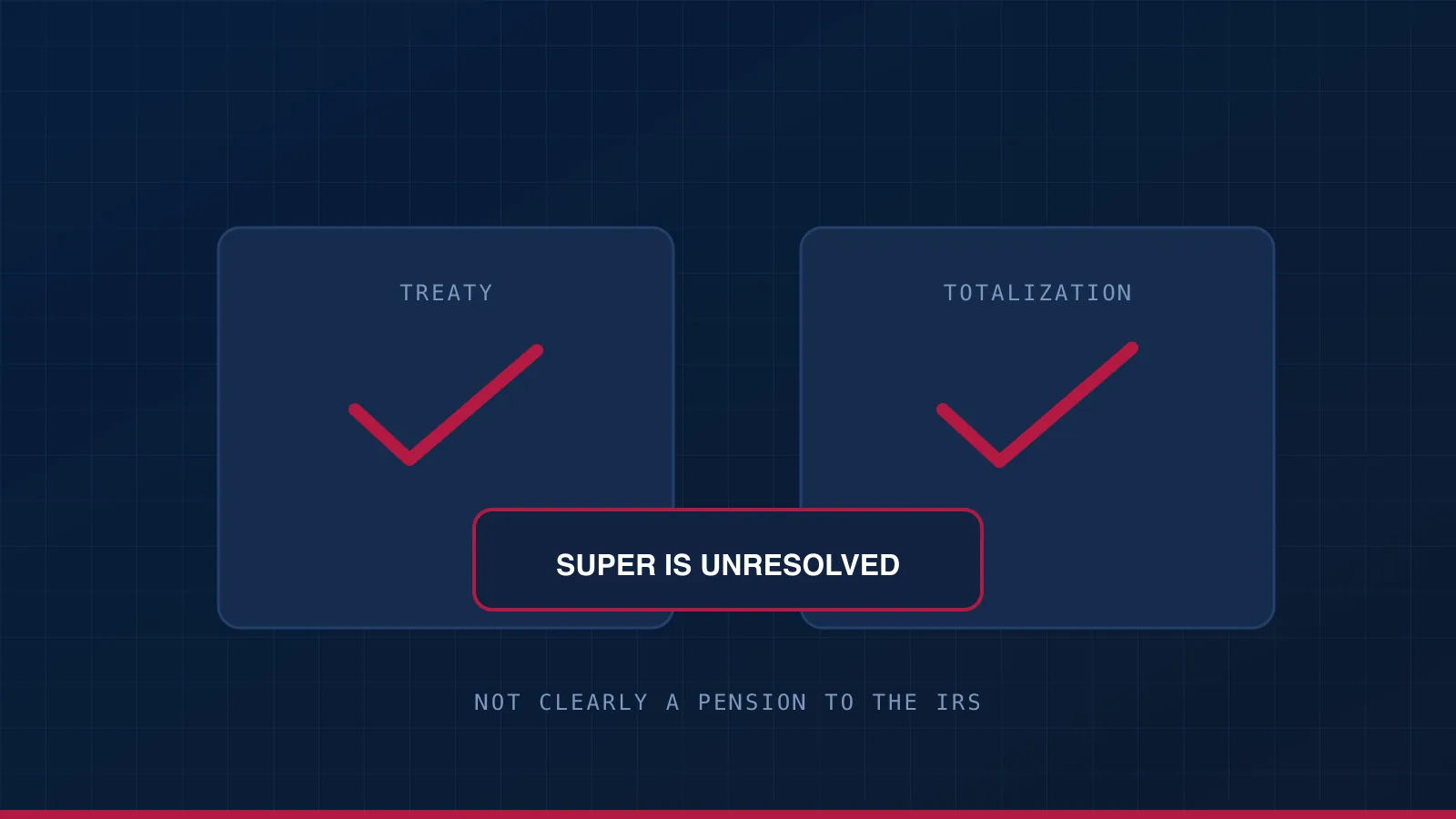

Super is the question, and it does not have one answer
Superannuation is tax-favoured in Australia and is not clearly a pension for US treaty purposes. Depending on how a particular fund is characterised, employer contributions, employee contributions and internal earnings may be currently taxable to you in the United States, with reporting obligations attached.
A self-managed super fund raises the question in its sharpest form, because the analysis can bring trust reporting into a return that otherwise had none. This is a position to take deliberately with the fund documents in hand — not one to inherit from a forum post.
Franking credits work against you, not for you
Franking credits reduce Australian tax on dividends. They are not creditable against US tax, and the grossed-up dividend that comes with them can increase your US taxable income — the opposite of the effect most people expect from something described as a credit.
The Australian system is doing something the US system has no equivalent for, and the treaty does not translate it.
Australian funds are usually PFICs
Australian managed funds and listed investment companies are foreign mutual funds for US purposes, which makes them passive foreign investment companies. An ordinary local investment account therefore carries Form 8621 and a default calculation that taxes a disposal at the highest ordinary rate across the holding period, with interest.
Two tax years that do not align
The Australian tax year runs 1 July to 30 June; the US year is the calendar year. Australian tax paid in one Australian year therefore spans two US years, and whether you claim credits when paid or when accrued decides how that is handled. The choice is effectively permanent, so the first Australian return matters more than the ones that follow.
The Medicare levy, and the totalization agreement
The Medicare levy is charged as part of the income tax assessment and is generally creditable with the income tax it accompanies. Social security itself is handled by the totalization agreement, which assigns coverage to one country and takes the 15.3% US self-employment charge off a self-employed American covered in Australia — on a certificate of coverage.
A worked example, tax year 2025
A single American employed in Sydney on $165,000, with Australian income tax and Medicare levy of $58,000 for the year. Australian figures are illustrative; the US figures are computed.
Scroll the table sideways
IRC §901, §904, §911 and §1291–1298; US–Australia income tax treaty; US–Australia totalization agreement; IRS Publication 54; IRS Publication 514; IRS Form 8621 and Form 8938 instructions; Australian superannuation, the Medicare levy and the franking credit system; Rev. Proc. 2025-32; 31 CFR 1010.350. US figures are tax year 2025. Checked 22 September 2026.
Questions Americans in Australia ask
Is my superannuation tax-deferred for US purposes?
Not automatically. Super is tax-favoured in Australia and not clearly a pension for US treaty purposes, so contributions and internal earnings may be currently taxable to you in the US depending on how the fund is characterised.
Can I use franking credits on my US return?
No. They are not creditable against US tax, and the grossed-up dividend they accompany can increase your US taxable income — the opposite of what the word credit suggests.
The Australian tax year ends in June. How does that work with a US return?
By apportioning. Australian tax paid in one Australian year spans two US calendar years, and whether you claim credits when paid or when accrued decides how the split is handled. That choice is effectively permanent.
Is the Medicare levy creditable?
Generally yes — it is charged as part of the income tax assessment and is creditable with the income tax it accompanies. Social security is a separate question, handled by the totalization agreement.
I have not filed for several years while in Australia. What now?
If the failure was non-willful — which describes most people in this position — the Streamlined Foreign Offshore Procedures waive the failure-to-file, failure-to-pay and FBAR penalties: three years of returns, six years of FBARs, and Form 14653.
Filing from Australia?
Twenty minutes settles what position your super is on, and whether your Australian investments carry Form 8621.