US tax for Americans in Bahrain
There is no US–Bahrain income tax treaty and no totalization agreement. Bahrain taxes no employment income, and the social insurance withheld from an expatriate payslip is not an income tax — so there is nothing to credit, and the Foreign Earned Income Exclusion and the foreign housing exclusion carry the return on their own.
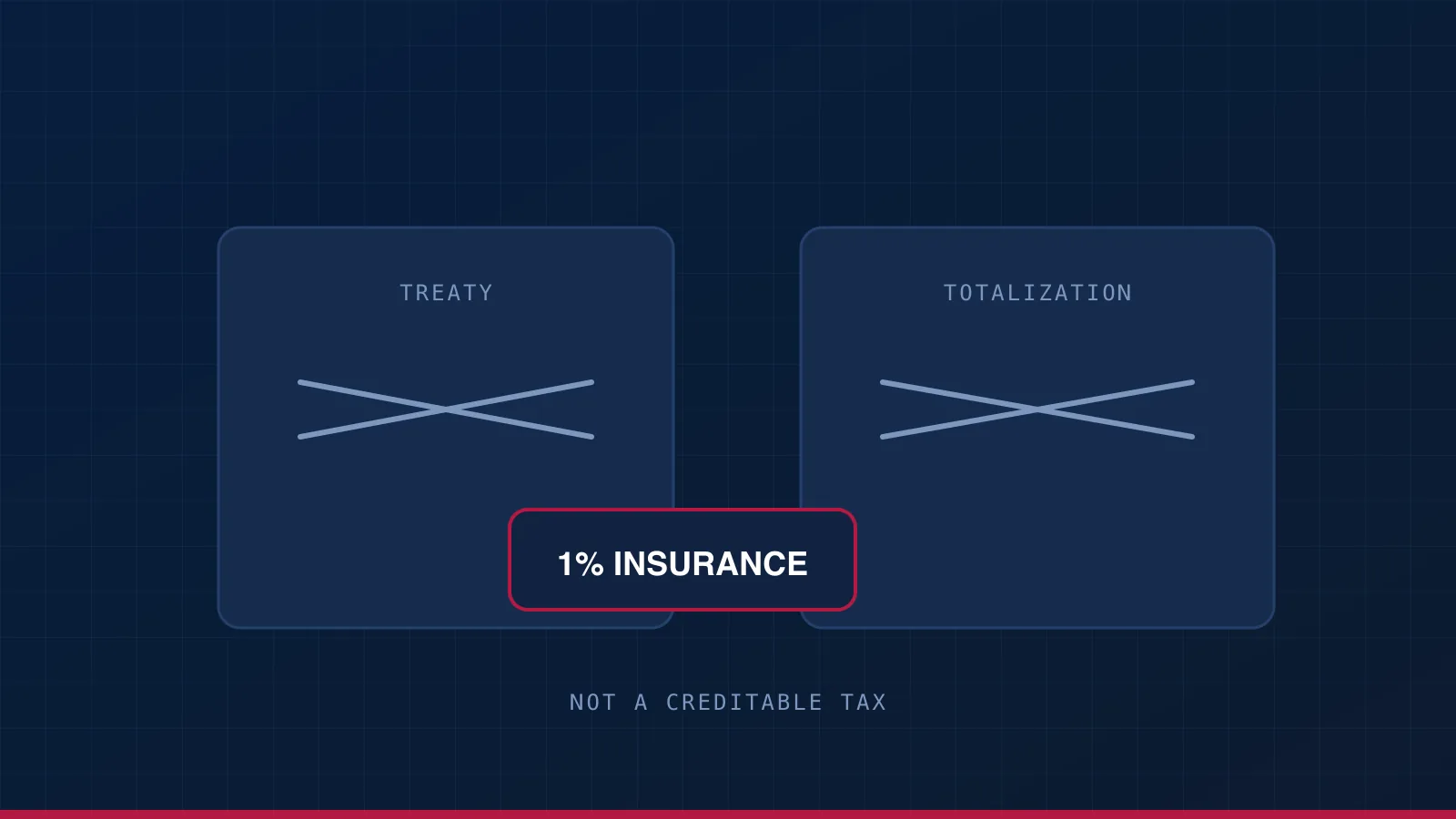

No treaty, no totalization, and nothing creditable
Citizenship decides who files, so a move to Manama changes the arithmetic rather than the obligation. There is no US–Bahrain income tax treaty and no totalization agreement, and Bahrain levies no personal income tax on employment income. The Foreign Earned Income Exclusion, $130,000 for tax year 2025, and the foreign housing exclusion are what the return runs on.
Because nothing is taxed locally, there is no foreign tax credit waiting behind the exclusion. Income above the excluded amount is taxed at US rates with nothing to offset it — which makes the housing exclusion and the day-count the whole of the planning.
The deduction on your payslip is insurance, not tax
Expatriate employees in Bahrain are covered for work injury rather than the full social insurance scheme that applies to Bahraini nationals: the employer contributes 3% of wages and the employee 1%. That 1% is visible on the payslip and is regularly mistaken for income tax withholding. It is not one, and it produces no foreign tax credit — a foreign levy has to be an income tax in the US sense before it can be credited.
Since 1 March 2024, employers also contribute to a Social Insurance Organisation fund covering the end-of-service benefit for expatriate staff, at 4.2% of monthly wage for the first three years of service and 8.4% after that. Those are employer contributions rather than your income when they are made; the benefit is compensation for services performed abroad when it is earned.
Living in Bahrain and working in Saudi Arabia
The causeway commute is common enough to be its own filing pattern, and it does not split the US return — worldwide income is reported either way. What it changes is the evidence. Your tax home follows your main place of business, so a Bahraini residence paired with Saudi employment needs the record to say clearly where each was, and a contemporaneous travel log is worth more than a reconstruction two years later.
The housing exclusion is smaller here, and still worth claiming
Bahrain rents sit below Dubai and Doha, which usually means a smaller housing exclusion — not a reason to skip it. Qualified housing expenses count above a base amount of 16% of the exclusion, $20,800 for tax year 2025, and are capped at 30%, or $39,000. Rent, utilities other than telephone, and renters' insurance count toward it.
Self-employment is where the real cost sits
Consulting and contract work through a Bahraini entity or directly for a US client is self-employment for US purposes, and with no totalization agreement there is nothing to relieve it: 15.3% self-employment tax applies to net earnings even when the exclusion takes income tax to zero. It is the single largest surprise on returns filed from Bahrain.
A worked example, tax year 2025
A project manager employed by a Bahraini company, single, qualifying under the physical presence test, renting in Manama with a housing allowance in the contract.
Scroll the table sideways
IRC §901, §911, §1401 and §1402; IRS Publication 54; IRS Publication 514; Bahrain Social Insurance Organisation contribution schedules, including the end-of-service benefit scheme effective 1 March 2024; Social Security Administration totalization agreement list; IRS Streamlined Filing Compliance Procedures; Rev. Proc. 2025-32; 31 CFR 1010.350. Figures are tax year 2025. Checked 22 September 2026.
Questions Americans in Bahrain ask
I live in Bahrain and work in Saudi Arabia. Which country matters?
Both, for different reasons. The US return reports worldwide income whichever side of the causeway earned it; what the arrangement changes is where your tax home sits and what evidence supports it. Keep a contemporaneous record of days and workplace.
Are my social insurance contributions creditable?
No. The 1% withheld from an expatriate salary funds work-injury cover, not an income tax, and only an income tax in the US sense can be credited. It does not reduce foreign earned income either.
What is the end-of-service benefit scheme employers now pay into?
Since 1 March 2024 employers contribute to a Social Insurance Organisation fund for expatriate staff — 4.2% of monthly wage for the first three years of service and 8.4% afterwards. The contributions are the employer's; the benefit is your compensation for services performed abroad.
I consult for a US client from Bahrain. What changes?
Self-employment tax. With no totalization agreement, 15.3% SECA applies to net self-employment earnings regardless of what the exclusion does to income tax. An employee on a Bahraini payroll does not have this exposure.
I have not filed for several years while in Bahrain. What now?
If the failure was non-willful — which describes most people in this position — the Streamlined Foreign Offshore Procedures waive the failure-to-file, failure-to-pay and FBAR penalties: three years of returns, six years of FBARs, and Form 14653.
Living in Bahrain, working across the causeway?
Twenty minutes settles which days count, what the housing exclusion is worth, and whether anything is creditable at all.