US tax for Americans in Bulgaria
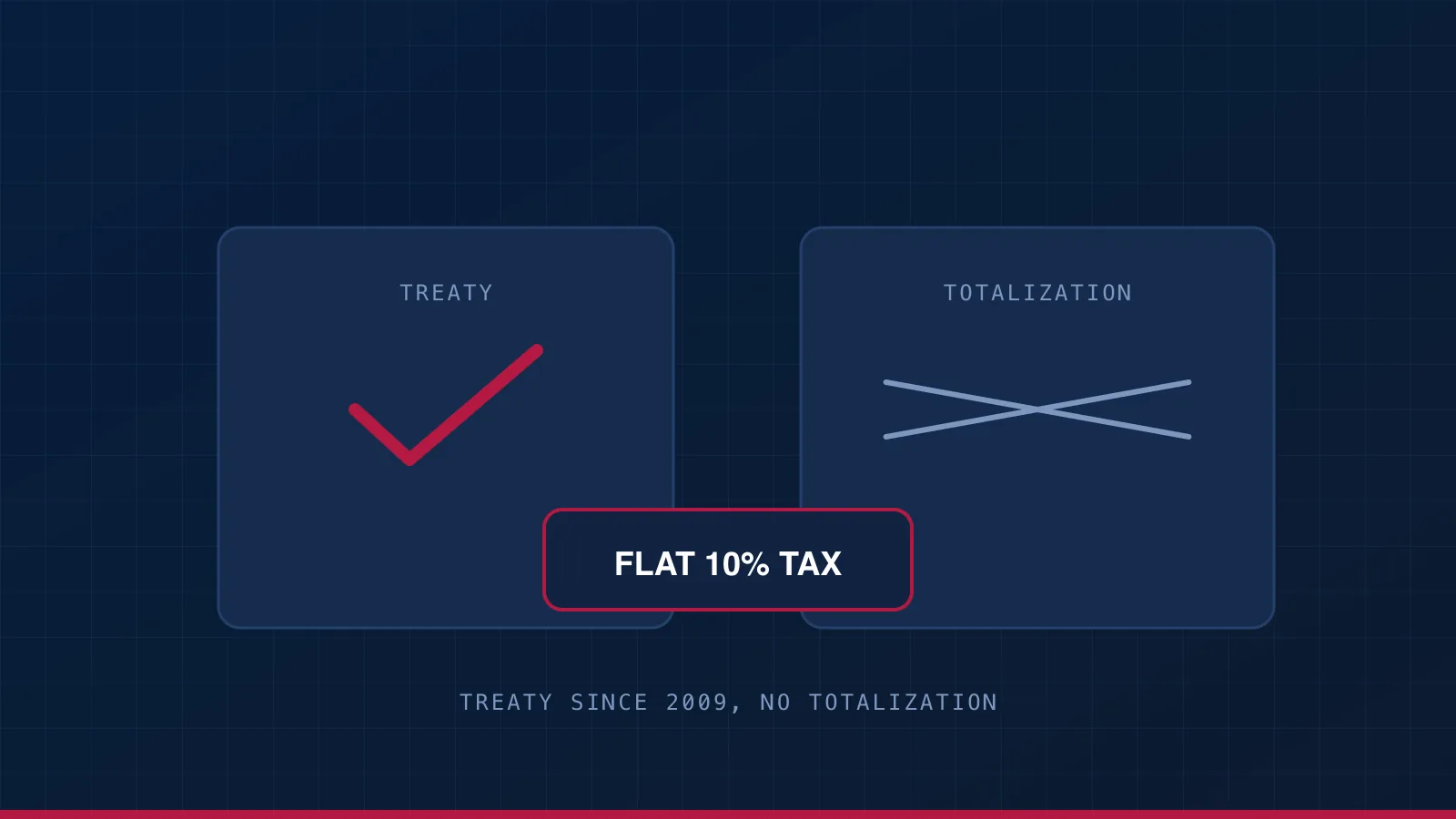
The US–Bulgaria income tax treaty has applied since 1 January 2009, but there is no totalization agreement, so self-employment tax runs at 15.3%. Bulgaria taxes residents on worldwide income at a flat 10%, which is below the US rate on income above the exclusion. The credit therefore leaves US tax to pay, and the euro, adopted on 1 January 2026, changes how Bulgarian tax is reported.

The US–Bulgaria tax treaty is in force
The US–Bulgaria income tax treaty was signed in 2007, entered into force on 15 December 2008 and has applied since 1 January 2009. It is one of the more modern US treaties, and it does the usual work: a residency tie-breaker, rules for pensions and dividends, and a procedure for resolving disagreements between the two tax authorities.
Where both countries could treat you as a resident, the tie-breaker decides, and Bulgaria applies it ahead of its own domestic tests. What the treaty does not do is stop the US taxing its citizens. Like every US treaty it contains a saving clause, so the US keeps taxing you as if the treaty did not exist, apart from the exceptions the treaty lists.
No totalization agreement, so 15.3% applies
Treaties cover income tax, not social security tax. Bulgaria has no totalization agreement with the United States, so a self-employed American pays US self-employment tax at 15.3%, whatever they pay in Bulgaria.
Bulgarian social security and health contributions are substantial, together 32.7% to 33.4% of insurable income across employer and employee, and they are not creditable against US tax. Bulgaria's labour ministry lists the USA among the countries it has prioritised for social-security negotiations in 2025 to 2026. That could change the position, so the date this page was checked matters.
A flat 10% is low, which matters for the credit
Bulgaria taxes tax residents on worldwide income at a flat 10%, with a final 5% tax on dividends and 10% on capital gains. There is no net wealth tax, and property tax is set by each municipality at between 0.01% and 0.45% of the tax value of the property. Neither is an income tax, so neither is creditable against US income tax.
The US charges higher rates than 10% on income above the foreign earned income exclusion, so Bulgarian tax paid on that income does not cancel the US tax. Tax paid on income you exclude cannot also be credited. The exclusion usually comes first, and the credit matters for what sits above it, such as dividends and gains.
Bulgaria tax residency: when you become a resident
Bulgaria taxes tax residents on worldwide income and non-residents only on Bulgarian-source income. You are resident if you are in Bulgaria more than 183 days in any 12-month period, in which case you become resident in the calendar year in which the 183rd day passes, or if your centre of vital interests is in Bulgaria. A permanent address counts only together with that centre, and an assignment abroad by a Bulgarian company or the State also makes you resident.
Where both countries claim you, the treaty's tie-breaker decides. That is the useful part of having a treaty here, and it should be settled before the first Bulgarian return rather than after.
The euro changes the paperwork, not the rules
Bulgaria adopted the euro on 1 January 2026, replacing the lev at a fixed rate of 1.95583 leva to the euro. Bulgarian tax and social security returns for periods ending on or before 31 December 2025 are in leva, and those for periods from 1 January 2026 are in euros.
Your US return is in dollars either way. The fixed rate links the lev to the euro, not to the dollar, so each year's income and Bulgarian tax still need a consistent, published dollar rate, applied the same way to the income and to the tax you claim as a credit.
A worked example, tax year 2025
A single American freelancing from Sofia, $$70,000 of net self-employment earnings, with the 330-day test met. The US figures are computed.
Scroll the table sideways
IRC §901, §904, §911, §1401 and §1402; IRS Table 3 (List of Tax Treaties, updated through 26 September 2025; TIAS 08-1215.1); IRS Publication 54; IRS Publication 514; IRS Form 8938 instructions; Bulgarian Ministry of Labour and Social Policy, agreements on social security; National Social Security Institute of Bulgaria, list of effective international agreements; Bulgarian residence rules, flat income tax, contributions and euro adoption (PwC Worldwide Tax Summaries); Rev. Proc. 2025-32; 31 CFR 1010.350. US figures are tax year 2025. Checked 19 November 2026.
Questions Americans in Bulgaria ask
Is there a US–Bulgaria tax treaty?
Yes. It was signed in 2007, entered into force on 15 December 2008 and has applied since 1 January 2009. As with every US treaty, a saving clause lets the US keep taxing its citizens.
What is the tax rate in Bulgaria for Americans living there?
The Bulgaria tax rate is a flat 10% on a tax resident's income, with a final 5% tax on dividends and 10% on capital gains. Because that is below the US rate on income above the exclusion, Bulgarian tax rarely removes the US tax on that income.
Does Bulgaria tax foreign income?
For tax residents, yes: Bulgaria taxes residents on worldwide income, while non-residents are taxed only on Bulgarian-source income. Where both countries claim you, the treaty's tie-breaker decides residence.
Do I pay US self-employment tax in Bulgaria?
Yes, at 15.3%, because there is no totalization agreement. Bulgarian social security and health contributions do not reduce it.
How does Bulgaria tax residency work?
Bulgarian tax residency follows more than 183 days in Bulgaria in any 12-month period, or your centre of vital interests being there. A permanent address counts only together with that centre. Where the treaty applies, its tie-breaker comes first.
Did the euro change anything for my US return?
It changes the currency Bulgaria reports in, not what you file. Bulgarian returns for periods to 31 December 2025 are in leva and those from 1 January 2026 are in euros. Your US return is in dollars, so translate each year's income and Bulgarian tax at a consistent, published dollar rate.
I have not filed for several years while in Bulgaria. What now?
If the failure was non-willful — which describes most people in this position — the Streamlined Foreign Offshore Procedures waive the failure-to-file, failure-to-pay and FBAR penalties: three years of returns, six years of FBARs, and Form 14653.
Filing from Bulgaria?
Fifteen minutes settles when your Bulgarian residence began and how the credit and the exclusion fit together.