US tax for Americans in Canada
There is a US–Canada income tax treaty and a totalization agreement, so double income tax is addressable, Canadian tax is creditable and self-employment tax is relievable with a certificate of coverage. Combined federal and provincial rates pass 50% in several provinces, which makes the credit the straightforward part. The registered accounts are not.
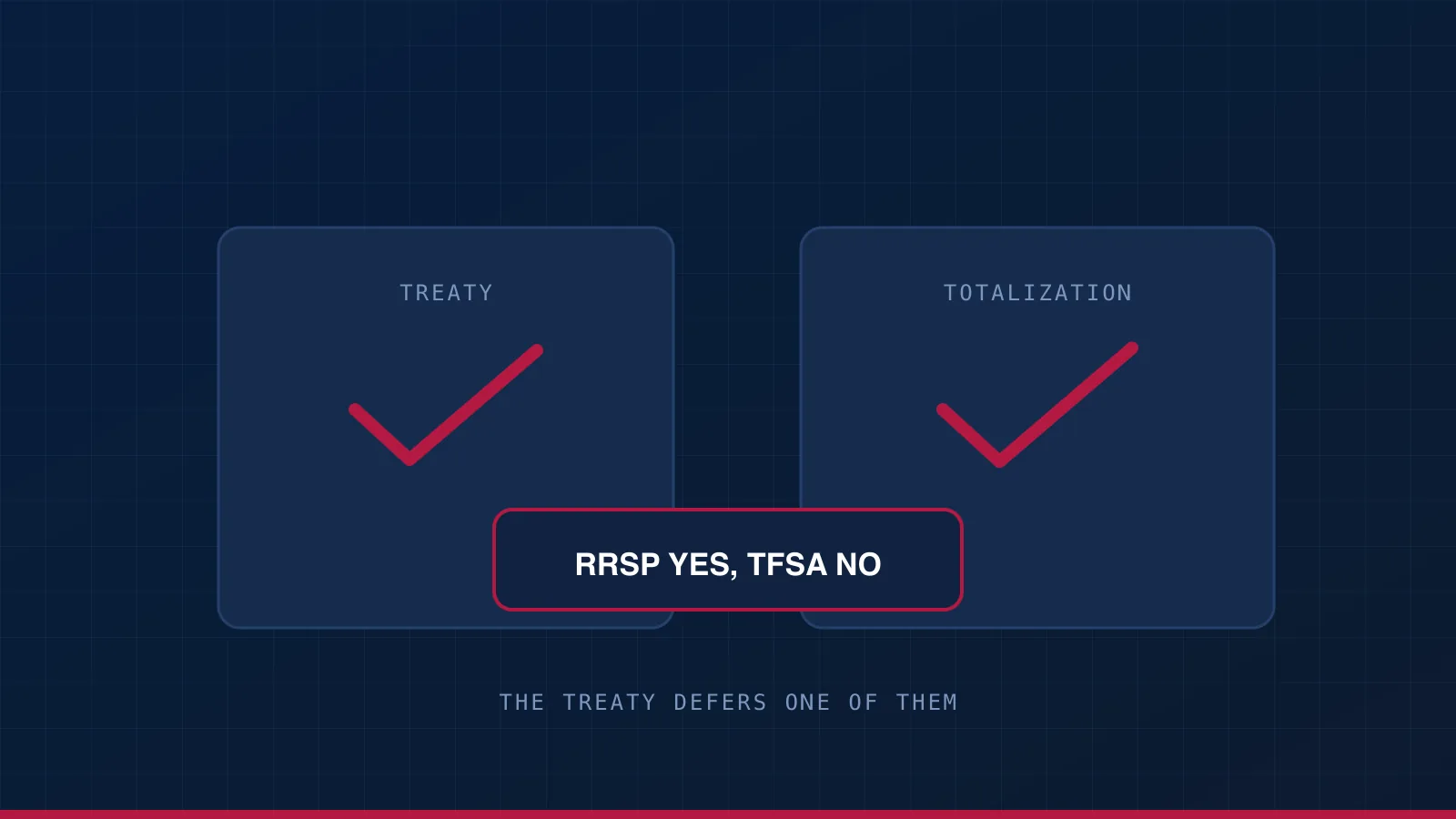

The RRSP is the good news
Article XVIII(7) of the treaty defers the internal growth of an RRSP for US purposes, and since Rev. Proc. 2014-55 the election is automatic rather than something to attach to a return each year. That is the one registered account whose Canadian treatment carries across cleanly.
Everything else in the Canadian registered alphabet needs its own analysis, and most of it does not end well.
The TFSA is the bad news, and it is the common one
Nothing in the treaty makes a TFSA tax-free to the United States. The income inside it is US taxable year by year, and the funds held in one are usually Canadian mutual funds or ETFs — which makes them PFICs, with Form 8621 and a default calculation that taxes a disposal at the highest ordinary rate across the holding period, with interest.
It is the single most common Canadian surprise: an account opened precisely because it was tax-free is frequently the most expensive item on the American return.
An RESP is often worse
The same wrapper problem applies, with an addition: the government grant is taxable income to the US subscriber, and the trust analysis can bring Form 3520 and Form 3520-A into a return that otherwise had none. Opening one for a child's education is a decision worth taking with the US side visible.
Canadian funds are PFICs, registered or not
Canadian mutual funds and ETFs are foreign mutual funds for US purposes, including those held in an ordinary non-registered account. A Canadian-resident American with a diversified local portfolio can be holding a dozen PFICs without anything unusual having happened.
The departure tax, and when it lands
Canada charges a departure tax — a deemed disposition of most property — when you cease Canadian residence. It is a Canadian charge with US timing consequences, because the US taxes the same gain when it is actually realised, which may be a different year entirely. A credit only helps in the year the matching income is taxed on the US side, so the sequencing needs planning before the move rather than after.
A worked example, tax year 2025
A single American employed in Toronto on $150,000, with Canadian federal and provincial tax of $52,000 for the year. Canadian figures are illustrative; the US figures are computed.
Scroll the table sideways
IRC §901, §904, §911 and §1291–1298; US–Canada income tax treaty, including Article XVIII(7); Rev. Proc. 2014-55; US–Canada totalization agreement; IRS Publication 54; IRS Publication 514; IRS Form 8621, Form 8938 and Form 3520 instructions; Canadian federal and provincial income tax and the departure tax on ceasing residence; Rev. Proc. 2025-32; 31 CFR 1010.350. US figures are tax year 2025. Checked 22 September 2026.
Questions Americans in Canada ask
Is my TFSA tax-free on my US return?
No. Nothing in the treaty makes it tax-free to the United States, so the income inside is taxable year by year — and the funds held in one are usually PFICs, which brings Form 8621.
Does the treaty defer my RRSP?
Yes. Article XVIII(7) defers the internal growth for US purposes, and since Rev. Proc. 2014-55 the election is automatic rather than something to attach each year. The RRSP is the account that works cleanly.
What about an RESP?
Often worse than a TFSA. The government grant is taxable income to the US subscriber, and the trust analysis can bring Form 3520 and Form 3520-A into the return.
When does the Canadian departure tax hit my US return?
Not when Canada charges it. Canada deems a disposition on ceasing residence; the US taxes the gain when it is actually realised, which can be a different year — and a credit only helps in the year the matching income is taxed on the US side.
I have not filed for several years while in Canada. What now?
If the failure was non-willful — which describes most people in this position — the Streamlined Foreign Offshore Procedures waive the failure-to-file, failure-to-pay and FBAR penalties: three years of returns, six years of FBARs, and Form 14653.
Filing from Canada?
Twenty minutes settles what your registered accounts are doing on the American return — which is where Canadian files go wrong.