US tax for Americans in China
There is a US–China income tax treaty, and Chinese individual income tax is progressive to 45%, so the foreign tax credit is usually available and often better than the exclusion. There is no totalization agreement, which is why 15.3% US self-employment tax survives everything the treaty does — and two Chinese rules, the six-year rule and the expat fringe benefits, carry their own dates.
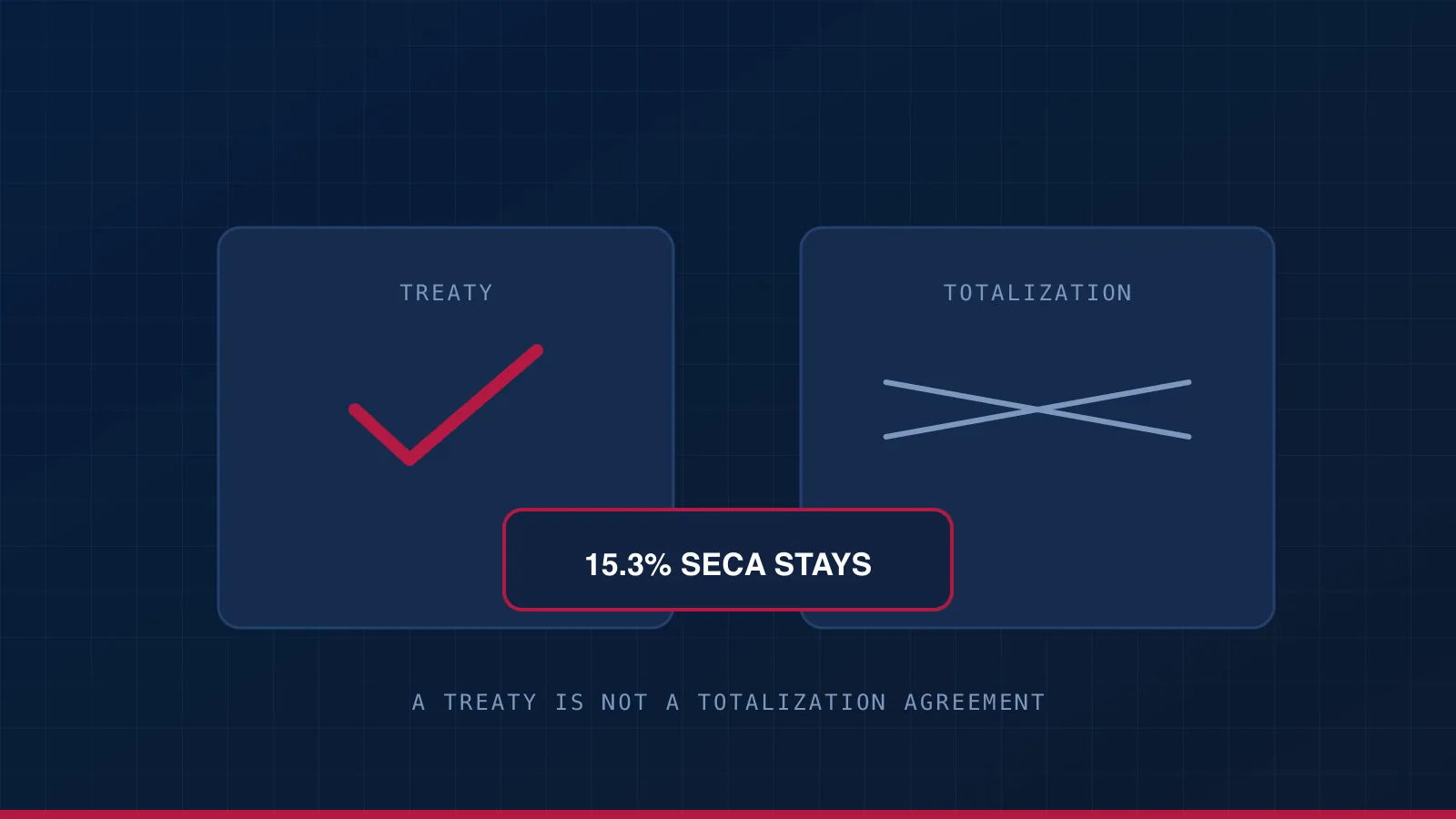

One instrument, not two
A tax treaty and a totalization agreement are different things, and the difference is the whole of this article. The treaty relieves double income tax and makes Chinese individual income tax creditable; a totalization agreement would relieve double social security, and China does not have one with the United States.
An employed American is usually fine on that second point, because a Chinese salary is not subject to US Social Security tax in the first place. A self-employed one is not: 15.3% self-employment tax applies to net earnings on top of whatever China has already taken.
Chinese social insurance is not a creditable tax
Mandatory social insurance contributions in China are not income taxes. They do not belong on Form 1116, and with no totalization agreement in place they buy no relief from US self-employment tax either. They are a cost with no US offset — which surprises people who assume any compulsory deduction must be creditable somewhere.
The annual reconciliation moves your credit after the fact
Individual income tax is withheld monthly and reconciled annually. The reconciliation can produce a refund, and a refund of foreign tax reduces the foreign tax credit you already claimed on a US return that has been filed. Amended positions are normal here rather than a sign of error — and expecting one is better than being surprised by it.
The six-year rule, and what resets it
A foreign individual who is resident in China for 183 days or more in each of six consecutive years becomes taxable in China on worldwide income from the seventh. A single departure of more than thirty consecutive days in any year breaks the run and resets the count.
For a US citizen the Chinese exposure is only half the picture — the US already taxes worldwide income — but it changes which country taxes what first, and therefore which credit is available against which liability.
The expat fringe benefits have an end date
Foreign nationals who are Chinese tax residents can currently take eight categories of tax-exempt fringe benefits — housing rental, children's education, language training, meals, laundry, relocation, home leave and business travel — instead of the special additional deductions available to everyone. The two cannot be combined, and the preferential treatment has been extended to 31 December 2027.
None of that carries to the US return. Benefits exempt in China are still compensation for services performed abroad on Form 2555 or Form 1116, which is the most common mismatch on a Chinese package.
A worked example, tax year 2025
A single American consultant in Shanghai invoicing for their own services, $90,000 of net self-employment earnings, with $19,000 of Chinese individual income tax paid.
Scroll the table sideways
IRC §901, §904, §911, §1401 and §1402; US–China income tax treaty; IRS Publication 54; IRS Publication 514; Social Security Administration totalization agreement list; China's 2019 individual income tax reform and the six-year rule; the extension of preferential tax treatment for foreigners' fringe benefits to 31 December 2027; Rev. Proc. 2025-32; 31 CFR 1010.350. US figures are tax year 2025. Checked 22 September 2026.
Questions Americans in China ask
China has a treaty. Why do I still pay self-employment tax?
Because a tax treaty and a totalization agreement are different instruments. The treaty addresses income tax; only a totalization agreement can relieve US self-employment tax, and the United States and China do not have one.
Are my Chinese social insurance contributions creditable?
No. They are not income taxes, so they do not belong on Form 1116, and they do not relieve SECA either.
What is the six-year rule?
A foreign individual resident in China for 183 days or more in each of six consecutive years becomes taxable in China on worldwide income from the seventh year. A single absence of more than thirty consecutive days in a year breaks the run and resets the count.
My housing and school fees are tax-exempt in China. Are they exempt to the IRS?
No. The Chinese exemption for foreigners' fringe benefits — extended to 31 December 2027 — is a Chinese rule. On the US return those benefits are compensation for services performed abroad and belong in foreign earned income.
I have not filed for several years while in China. What now?
If the failure was non-willful — which describes most people in this position — the Streamlined Foreign Offshore Procedures waive the failure-to-file, failure-to-pay and FBAR penalties: three years of returns, six years of FBARs, and Form 14653.
Working or consulting in China?
Twenty minutes settles whether your arrangement is self-employment for US purposes, and what that costs on top of Chinese tax.