US tax for Americans in Colombia
There is no US–Colombia income tax treaty and no totalization agreement. Colombian tax residence begins at 183 days in any 365-day period, and from that point Colombia taxes worldwide income — including US-source income the United States is already taxing. With no treaty to allocate between them, the credit is the only mechanism available.
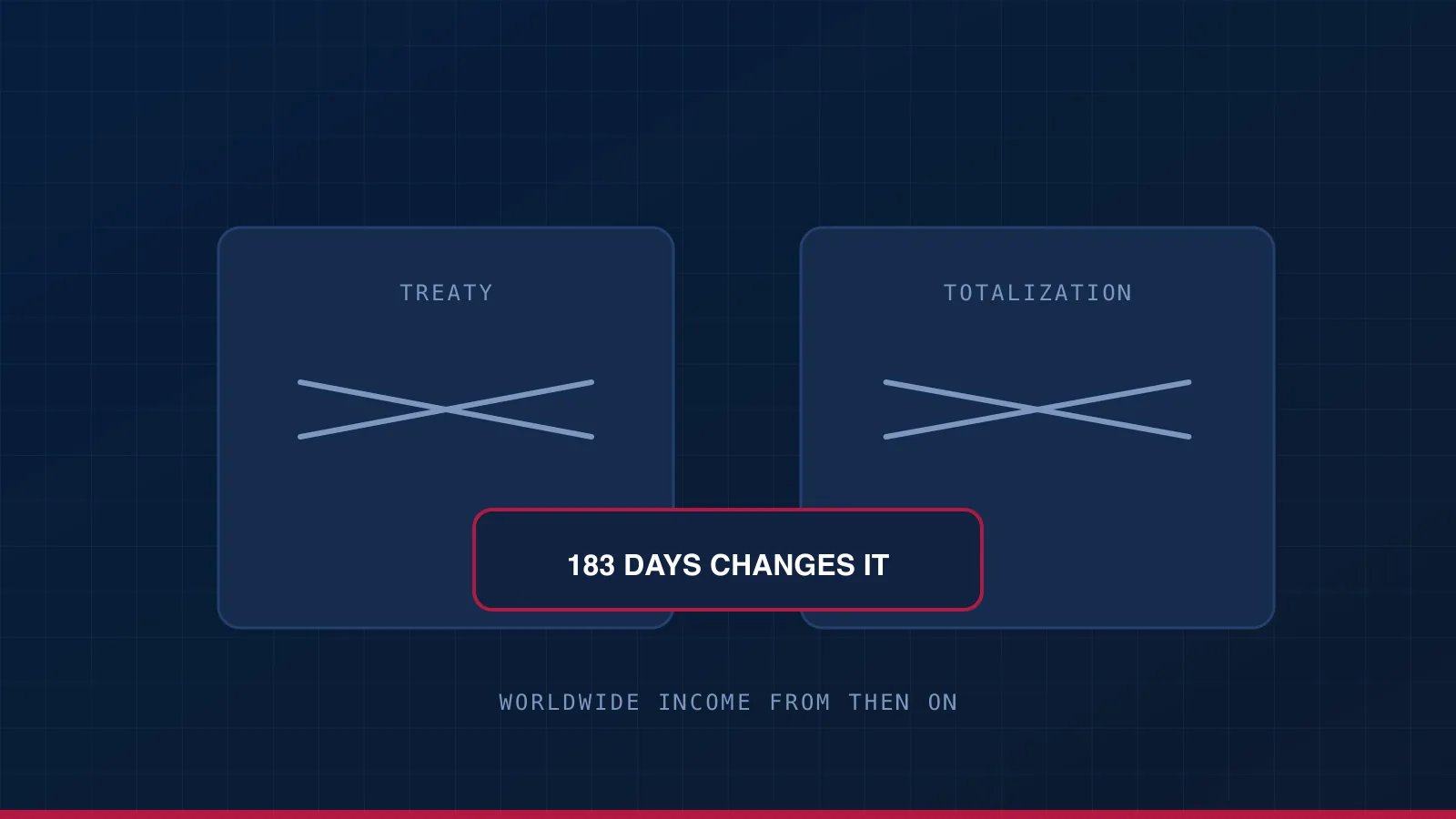

The 183-day line is the whole calendar
Colombian tax residence begins at 183 days in any 365-day period — a rolling window rather than a calendar year. From that point Colombia taxes worldwide income, which includes the US salary or US client income that brought you there.
Before that line, Colombia generally taxes only Colombian-source income and the US return is the ordinary expatriate one. After it, two systems are taxing the same income with no treaty to allocate between them.
Remote workers get the hardest version
Someone on a US payroll working from Medellín is the common case and the difficult one: the income is US-source, Colombia taxes it once residence starts, and there is no treaty article to say which country has the first claim.
The foreign tax credit is the mechanism that remains, and it works — Colombian income tax actually paid is creditable under the statute. What is missing is the tie-breaker that would have prevented the collision in the first place.
At 39%, the credit is usually competitive
Colombian rates reach 39%, so once residency begins the credit is generally competitive with the exclusion on employment income and often better. Before residency begins there is little Colombian tax to credit and the exclusion is doing the work.
That means the same person can have a different right answer in consecutive years, decided by a day-count rather than by anything they chose.
Not everything Colombia charges is creditable
Presumptive and wealth-based charges are not income taxes and do not belong on Form 1116. Only the income tax supports a credit, so the creditable figure can be smaller than the total Colombian bill.
Self-employment tax on top
There is no totalization agreement, so self-employment income carries the full 15.3% SECA charge in addition to whatever Colombia takes. For a freelancer that is frequently the largest single US item on the return.
A worked example, tax year 2025
A single American on a US payroll, resident in Colombia past the 183-day line, on $100,000 with Colombian income tax of $25,000. Colombian figures are illustrative; the US figures are computed.
Scroll the table sideways
IRC §901, §904, §911, §1401 and §1402; IRS Publication 54; IRS Publication 514; Social Security Administration totalization agreement list; Colombian tax residence rules and personal income tax rates; Rev. Proc. 2025-32; 31 CFR 1010.350. US figures are tax year 2025. Checked 22 September 2026.
Questions Americans in Colombia ask
When do I become a Colombian tax resident?
At 183 days in any 365-day period — a rolling window rather than a calendar year. From that point Colombia taxes worldwide income, including your US-source income.
Is there a US–Colombia tax treaty?
No, and no totalization agreement either. Colombian income tax is creditable under the statute, but there is no tie-breaker, no pension article and no mutual agreement procedure.
I work remotely for a US employer from Bogotá. What is the risk?
That both countries tax the same income once you pass 183 days, with no treaty to allocate between them. The credit is the only mechanism available, and it needs Colombian tax actually paid and documented.
Are Colombia's wealth-based charges creditable?
No. Presumptive and wealth-based charges are not income taxes, so only the Colombian income tax itself supports a credit on Form 1116.
I have not filed for several years while in Colombia. What now?
If the failure was non-willful — which describes most people in this position — the Streamlined Foreign Offshore Procedures waive the failure-to-file, failure-to-pay and FBAR penalties: three years of returns, six years of FBARs, and Form 14653.
Remote from Bogotá or Medellín?
Twenty minutes settles what day 183 does to your position, and which relief is actually available.