US tax for Americans in Costa Rica
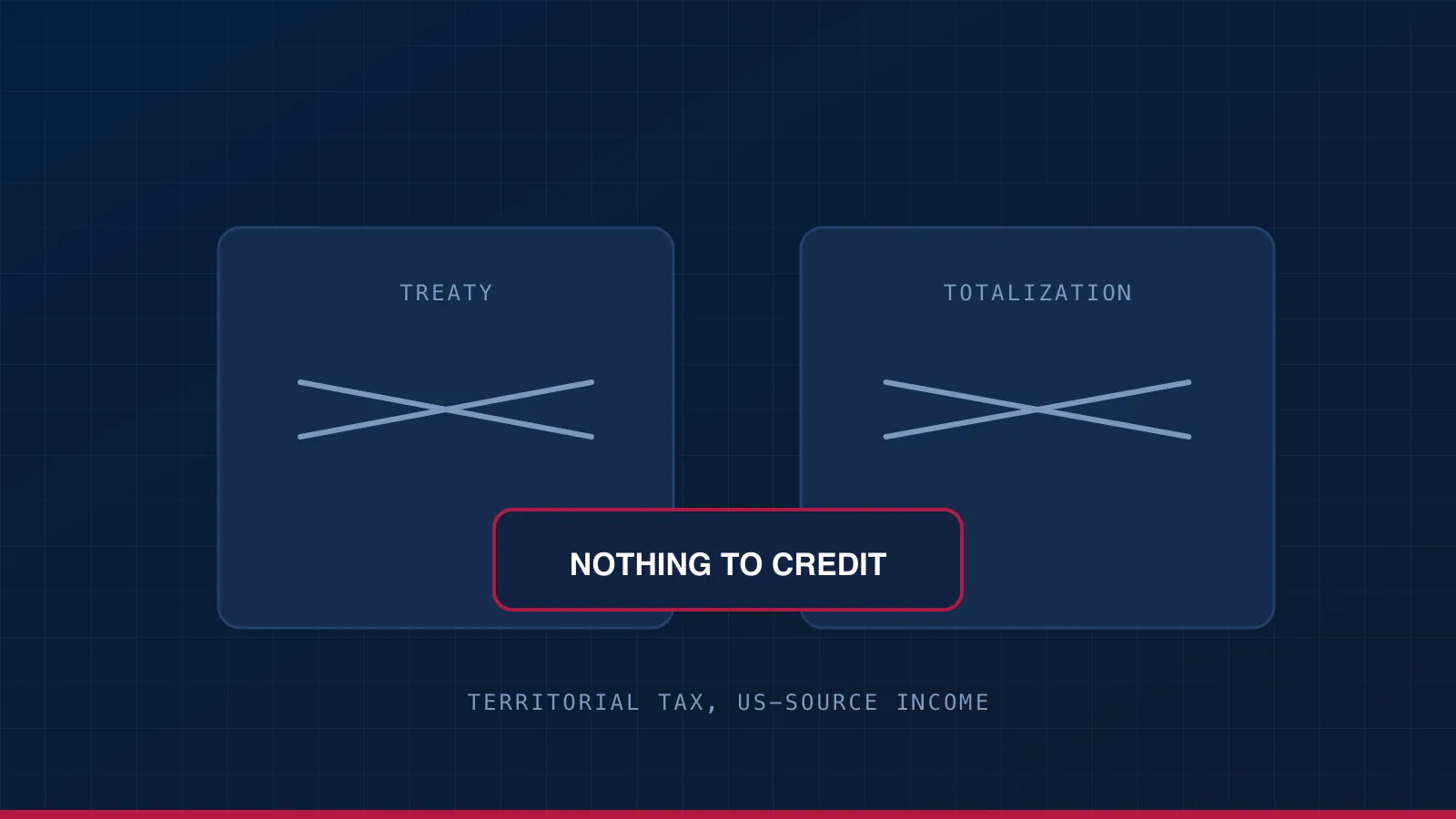
There is no US–Costa Rica income tax treaty and no totalization agreement, and Costa Rica taxes territorially — Costa Rican-source income only. For someone living on US income that means there is no Costa Rican tax to credit, so the Foreign Earned Income Exclusion, the housing exclusion and the qualifying period are the only levers available.

Territorial taxation is the whole story
Costa Rica taxes Costa Rican-source income and generally leaves foreign-source income alone. If your income is US-source — a US employer, US clients, a US pension — Costa Rica does not tax it, so there is no Costa Rican tax to credit on Form 1116.
That sounds like good news and is mostly neutral: the US still taxes the income in full, and the only relief available is the exclusion. There is no foreign tax sitting in reserve behind it.
Which makes the qualifying period the whole game
With no credit available, whether you qualify under the physical presence or bona fide residence test decides the entire return. A trip pattern that breaks the 330-day test costs real money here in a way it does not in a high-tax country, where a credit would have caught the income anyway.
The foreign housing exclusion is the second lever: qualified costs above 16% of the exclusion and capped at 30%, which for tax year 2025 means a base of $20,800 and a cap of $39,000.
Local clients change the analysis
Costa Rican-source income is taxed, at rates to 25%. Take local clients, run a local business or let property in Costa Rica and a creditable tax appears where there was none — which is a better position than it sounds, because it brings the credit into play alongside the exclusion.
Caja contributions are not creditable
CCSS contributions are social security rather than income tax and do not belong on Form 1116. Residency categories such as pensionado and rentista carry Caja obligations that are a real cost with no US offset — and with no totalization agreement, no relief from the US self-employment charge either.
No treaty means no tie-breaker
Without a treaty there is no residency tie-breaker and no mutual agreement procedure. Where the two systems disagree about something, there is no mechanism to resolve it between them — the risk sits with you, which is an argument for documenting positions as you take them.
A worked example, tax year 2025
A single American working remotely from Costa Rica for US clients, $85,000 of net self-employment earnings, with no Costa Rican-source income.
Scroll the table sideways
IRC §911, §1401 and §1402; IRS Publication 54; IRS Form 2555 instructions; Social Security Administration totalization agreement list; Costa Rican territorial taxation and CCSS contributions; Rev. Proc. 2025-32; 31 CFR 1010.350. US figures are tax year 2025. Checked 22 September 2026.
Questions Americans in Costa Rica ask
Do I pay Costa Rican tax on my US income?
Generally no. Costa Rica taxes territorially, so income from a US employer, US clients or a US pension is usually outside Costa Rican tax — which also means there is no Costa Rican tax to credit on your US return.
So living in Costa Rica means paying less US tax?
No. The US taxes worldwide income wherever you live. What changes is that no foreign tax is available to credit, so the exclusion and the housing exclusion are the only relief — which makes the qualifying period decisive.
Are my Caja contributions creditable?
No. CCSS contributions are social security rather than income tax, so they do not go on Form 1116 — and with no totalization agreement they relieve nothing on the self-employment side either.
What happens if I take Costa Rican clients?
Costa Rican-source income becomes taxable there at rates to 25%, which creates a creditable tax where none existed. That is generally a better position, because the credit comes into play alongside the exclusion.
I have not filed for several years while in Costa Rica. What now?
If the failure was non-willful — which describes most people in this position — the Streamlined Foreign Offshore Procedures waive the failure-to-file, failure-to-pay and FBAR penalties: three years of returns, six years of FBARs, and Form 14653.
Working remotely from Costa Rica?
Twenty minutes settles the qualifying period and the housing exclusion — the only two levers you have here.