US tax for Americans in Guatemala
Guatemala has no US income tax treaty and no totalization agreement, and it taxes territorially. Pay for work done outside the country is not taxed there, so a remote worker or a retiree living on US income generally has no Guatemalan tax to credit. The foreign earned income exclusion does all the work, and above it US tax is owed with nothing behind it.
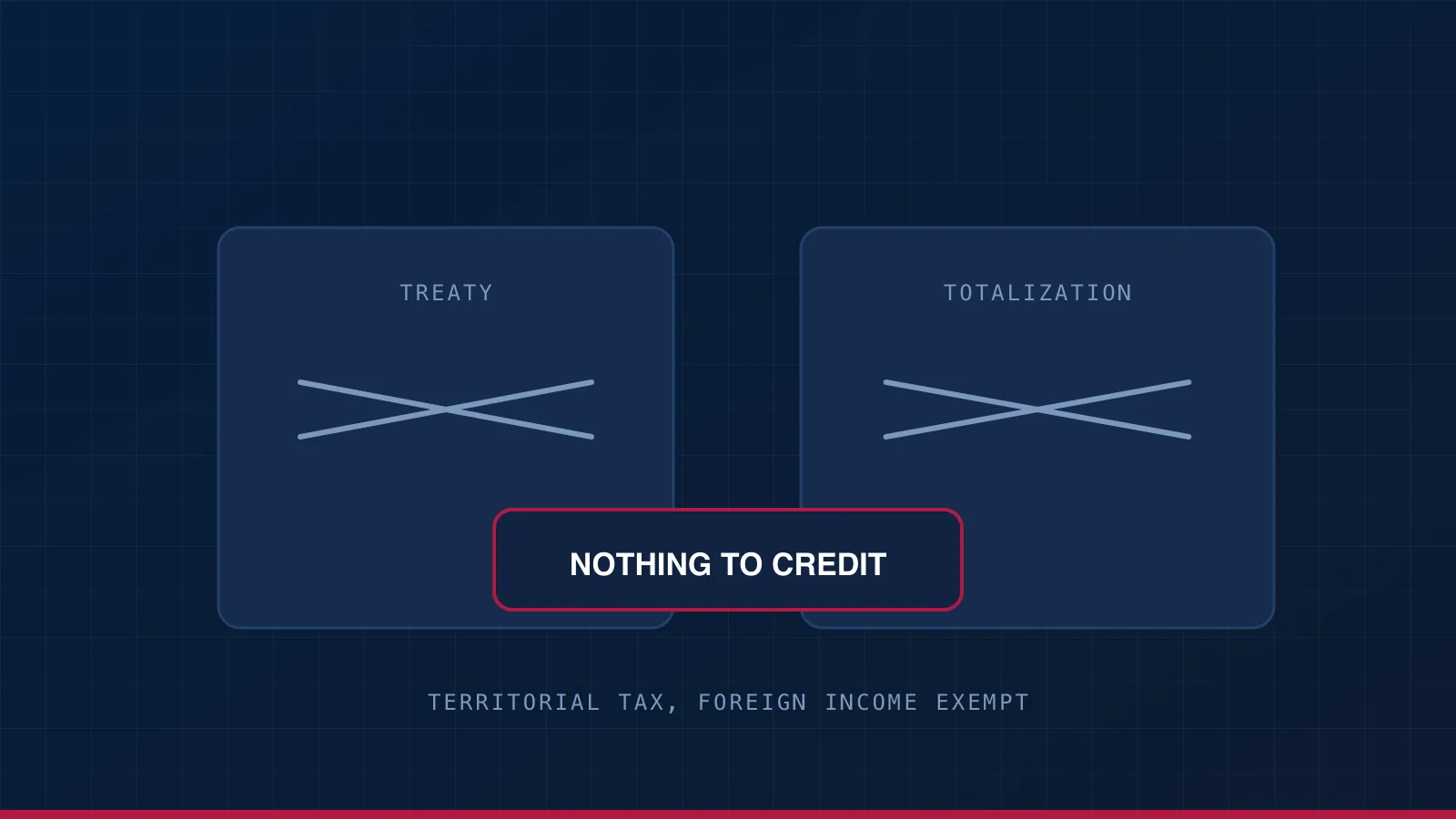

Territorial taxation is the story
Guatemala taxes income from Guatemalan sources. Compensation for services performed outside the country is not taxable there, and neither are capital gains and investment income from abroad. If your income is US-source, such as a US employer, US clients or a US pension, Guatemala generally taxes none of it.
That produces a result people do not expect from a country with a developed tax code: no local tax, so no foreign tax credit, and the return rests on the exclusion alone. Above the limit, US tax is owed with no Guatemalan tax behind it to reduce it.
When there is Guatemalan tax
Income earned in Guatemala is taxed. Under the employment regime the rate is 5% on the first GTQ 300,000 of annual income and 7% on the excess. An American paid by a Guatemalan employer, or paid for work performed in the country, has Guatemalan tax that is creditable on Form 1116.
That is the case where the exclusion-or-credit decision becomes a real calculation. Tax paid on income you exclude cannot also be credited, so the choice is made on the numbers for each year.
The levers that matter
With nothing to credit, the foreign earned income exclusion, the foreign housing exclusion and the qualifying period are the only levers. A trip pattern that breaks the 330-day physical presence test, or a residence that does not qualify as a tax home, costs real money here.
No treaties at all
Guatemala has no tax treaties in force with any country, and none with the United States. There is no residency tie-breaker, no pension article and no mutual agreement procedure. If a payer withholds Guatemalan tax on a payment to you, the question is whether it is a creditable income tax.
Guatemalan social security (IGSS) contributions are not income tax and are not creditable, and without a totalization agreement the 15.3% self-employment tax applies in full.
A worked example, tax year 2025
A single American freelancing from Antigua Guatemala for US clients, $$60,000 of net self-employment earnings, with the 330-day test met. The US figures are computed.
| Net self-employment earnings | $60,000 |
| Guatemalan income tax on US-client income | None — Guatemalan-source income only |
| US income tax after the exclusion | $0 |
| Self-employment tax, no totalization agreement | $8,478 |
| Treaty relief available | None — there is no treaty |
Scroll the table sideways
| Fact | Position |
|---|---|
| US income tax treaty | No |
| Totalization agreement | No |
| Local income tax | Territorial — Guatemalan-source income only; 5% and 7% |
| Self-employment tax (SECA) | 15.3%, no relief |
| FBAR threshold | $10,000 aggregate, any point in the year |
IRC §901, §904, §911, §1401 and §1402; IRS Table 3 (List of Tax Treaties, updated through 26 September 2025); Social Security Administration totalization agreement list; IRS Publication 54; IRS Form 2555 and Form 8938 instructions; Guatemalan territorial taxation and employment income rates (PwC Worldwide Tax Summaries); Rev. Proc. 2025-32; 31 CFR 1010.350. US figures are tax year 2025. Checked 12 November 2026.
Questions Americans in Guatemala ask
Do I pay Guatemalan tax on my US income?
Generally no. Guatemala taxes Guatemalan-source income, and compensation for services performed outside the country and investment income from abroad are not taxed there. The consequence for your US return is that there is no Guatemalan tax to credit.
So living in Guatemala means paying less US tax?
Only up to the Foreign Earned Income Exclusion, $130,000 for tax year 2025. Above it there is no foreign tax credit to fall back on, so the marginal dollar is taxed at US rates.
Is there a US–Guatemala tax treaty?
No. The IRS list of treaties in force does not include Guatemala, there is no totalization agreement, and Guatemala has no tax treaties in force with any country.
What if I work for a Guatemalan employer?
Then your pay is Guatemalan-source and taxed there, at 5% on the first GTQ 300,000 a year and 7% above. That tax is creditable on your US return, which changes the exclusion-or-credit calculation.
I have not filed for several years while in Guatemala. What now?
If the failure was non-willful — which describes most people in this position — the Streamlined Foreign Offshore Procedures waive the failure-to-file, failure-to-pay and FBAR penalties: three years of returns, six years of FBARs, and Form 14653.
Filing from Guatemala?
Fifteen minutes settles whether the exclusion or a credit works better for the way you are paid.