US tax for Americans in India
There is a US–India income tax treaty, so Indian income tax is creditable and double income tax is addressable. There is no totalization agreement, so US self-employment tax at 15.3% applies with no relief. On most Indian returns, though, the accounts are harder than the tax — mutual funds are PFICs, and NRE interest being exempt in India makes it no less taxable in America.
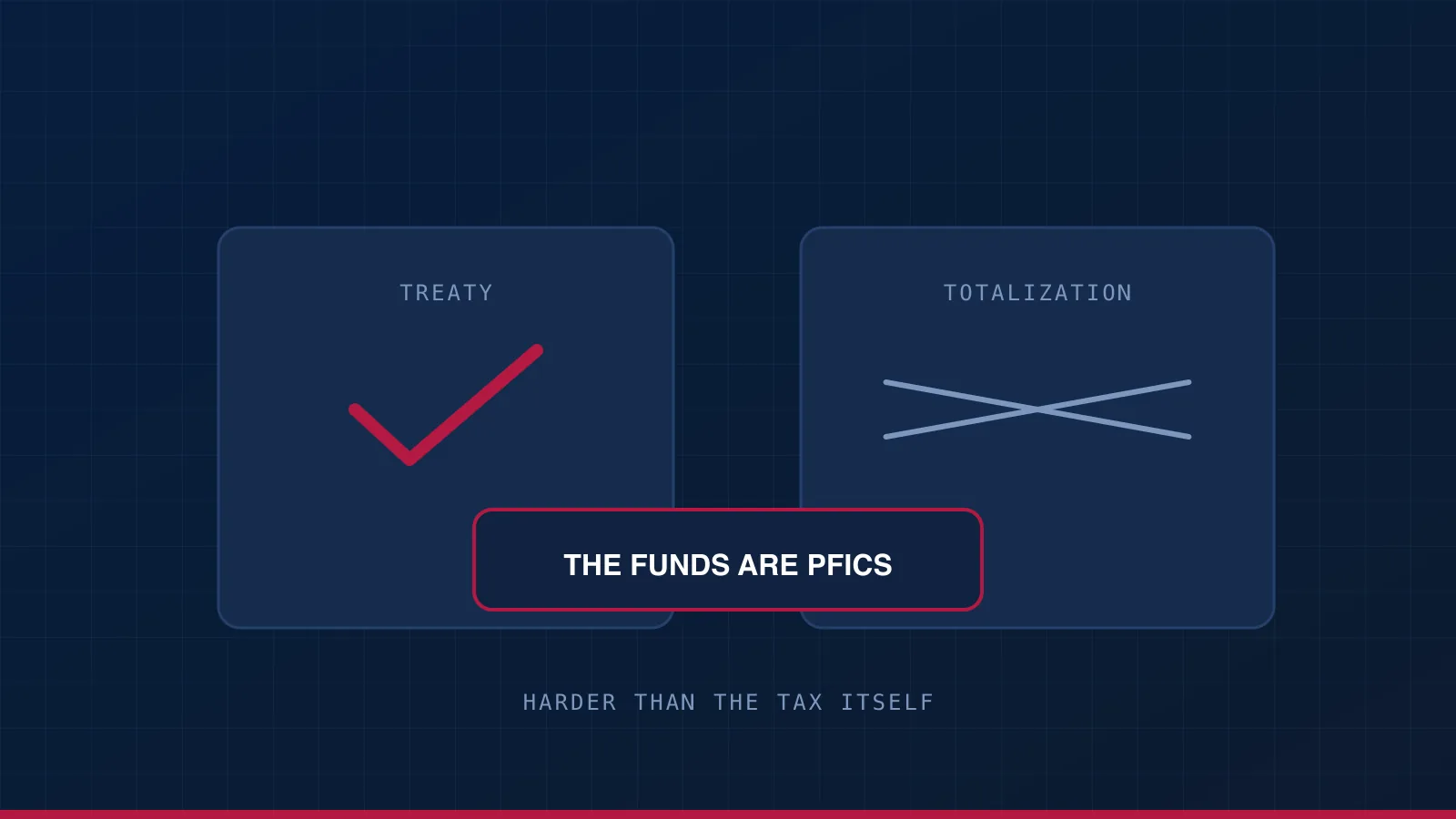

A treaty, and no totalization agreement
The treaty relieves double income tax: Indian income tax, including surcharge and cess, generally forms part of the creditable tax on Form 1116, and Article 25 governs how the credit works. Indian rates reach 30% before surcharge and cess, which usually makes the credit the better route on employment income.
There is no totalization agreement. For an employee that rarely matters; for a consultant invoicing from Bengaluru it means 15.3% self-employment tax on net earnings with nothing to relieve it.
Indian mutual funds are PFICs
This is the item that turns a simple Indian return into a long one. Indian mutual funds are foreign mutual funds for US purposes — passive foreign investment companies — which brings Form 8621, one for each fund, and under the default method a disposal is taxed at the highest ordinary rate for every year the holding was owned, with an interest charge on top.
A single SIP running for five years across three funds is three forms and three separate calculations. Nothing about this is visible from the Indian side, where the same investment is ordinary and tax-efficient.
PPF and EPF do not carry their treatment across
Both are tax-favoured in India and neither is automatically tax-deferred to the United States. There is no provision that makes them so, which means the growth inside can be currently taxable and the account reportable — and the answer is not the same for every arrangement.
NRE and NRO accounts, and the reporting that follows
Both count towards the FBAR $10,000 aggregate and towards Form 8938. NRE interest being exempt from Indian tax makes it no less US taxable income — and because no Indian tax was paid on it, there is nothing to credit against the US tax either.
That combination, exempt there and taxable here, is the reverse of what most people expect from a tax-free account.
Property, inheritance and the family arrangement
Agricultural land, inherited property or an interest in a Hindu Undivided Family raises Form 3520 and Form 8938 questions that are far cheaper to answer early than to unwind later. Say so at the start rather than when the return is being finished.
A worked example, tax year 2025
A single American employed in Bengaluru on $135,000, with Indian income tax, surcharge and cess of $40,000 for the year. Indian figures are illustrative; the US figures are computed.
Scroll the table sideways
IRC §901, §904, §911, §1291–1298, §1401 and §1402; US–India income tax treaty, including Article 25 on relief from double taxation; Social Security Administration totalization agreement list; IRS Publication 54; IRS Publication 514; IRS Form 8621, Form 8938 and Form 3520 instructions; Rev. Proc. 2025-32; 31 CFR 1010.350. US figures are tax year 2025. Checked 22 September 2026.
Questions Americans in India ask
Are my Indian mutual funds a problem on the US return?
Usually the largest one. They are PFICs, which means Form 8621 for each fund and a default calculation that taxes a disposal at the highest ordinary rate across the holding period with interest. An election can improve it, but it has to be made in time.
Is my NRE interest taxable in the US?
Yes. Being exempt from Indian tax does not make it exempt from US tax — and because no Indian tax was paid on it, there is nothing to credit against the US liability either.
Do I pay US self-employment tax on consulting work in India?
Yes, in full. There is no US–India totalization agreement, so 15.3% SECA applies to net self-employment earnings regardless of Indian tax paid or the credit claimed for it.
Are PPF and EPF tax-deferred for US purposes?
Not automatically. Indian deferral is not US deferral, and there is no provision making either arrangement automatically tax-deferred. The growth inside can be currently taxable and the account reportable.
I have not filed for several years while in India. What now?
If the failure was non-willful — which describes most people in this position — the Streamlined Foreign Offshore Procedures waive the failure-to-file, failure-to-pay and FBAR penalties: three years of returns, six years of FBARs, and Form 14653.
Filing from India?
Twenty minutes settles what your funds and accounts actually require, which is usually more work than the tax.