US tax for Americans in Ireland
There is a US–Ireland income tax treaty and a totalization agreement. Irish deductions come in three parts and they are not treated alike: income tax and the Universal Social Charge are income taxes for credit purposes, while PRSI is social insurance and belongs to the totalization agreement instead. Getting that split wrong either overstates the credit or throws part of it away.
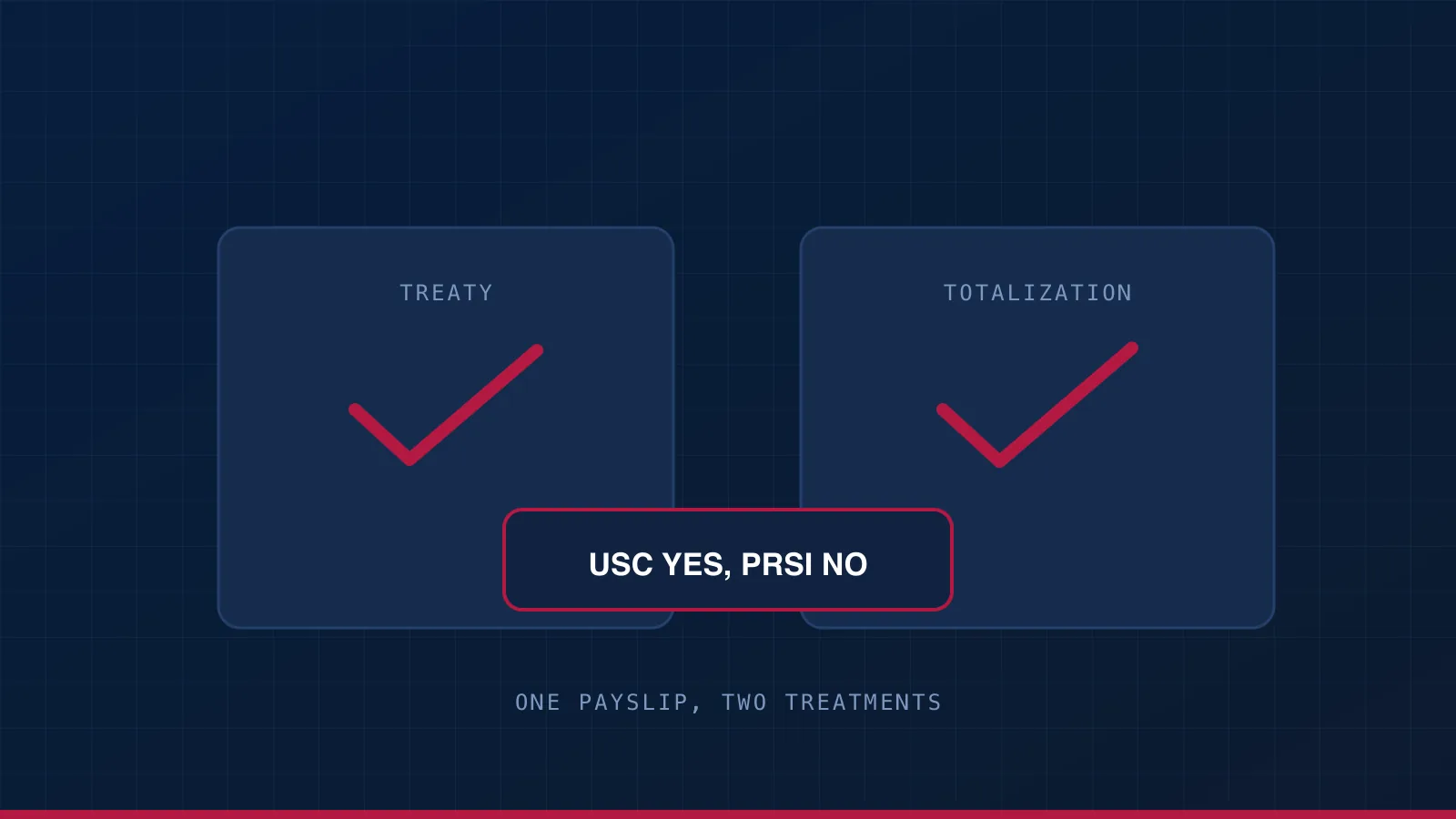

Three deductions, two treatments
An Irish payslip shows income tax, the Universal Social Charge and PRSI. Income tax and USC are income taxes for US purposes and belong on Form 1116. PRSI is social insurance: it is not creditable, and it is addressed by the totalization agreement instead.
Treating the whole deduction as one number goes wrong in both directions. Include PRSI and the credit is overstated; exclude USC and a substantial creditable tax is thrown away. Splitting the payslip correctly is most of the work on an Irish return.
What the totalization agreement does with PRSI
The agreement generally assigns your social security coverage to one country. Where Irish coverage applies, the 15.3% US self-employment charge falls away for self-employment income — on a certificate of coverage, which is the evidence rather than an assumption.
For an employee the question rarely arises, because a foreign salary is not subject to US Social Security tax in the first place. For a contractor invoicing from Dublin it is the single largest item on the return.
Irish and UCITS funds are PFICs
Ireland is where a great many European funds are domiciled, and Irish-domiciled UCITS are foreign mutual funds for US purposes — passive foreign investment companies. An entirely ordinary Irish investment account therefore carries Form 8621 and a default calculation designed to be unattractive: the highest ordinary rate for every year of the holding period, with an interest charge.
This catches Americans who buy a low-cost index fund locally precisely because it looked simple. The US treatment does not follow the Irish one, and the election that improves it has to be made in time rather than afterwards.
The credit usually wins, but not by as much as it looks
Irish income tax reaches 40% and USC adds to it, so the creditable total on a professional salary generally exceeds US tax on the same income and Form 1116 removes the liability. The carryforward is smaller than the headline deduction implies, though, because PRSI never belonged in the calculation.
A worked example, tax year 2025
A single American employed in Dublin on $145,000, with income tax and USC of $52,000 and PRSI of about $5,800. Irish figures are illustrative; the US figures are computed.
Scroll the table sideways
IRC §901, §904, §911 and §1291–1298; US–Ireland income tax treaty; US–Ireland totalization agreement; IRS Publication 54; IRS Publication 514; IRS Form 8621 instructions; Irish income tax, Universal Social Charge and PRSI; Rev. Proc. 2025-32; 31 CFR 1010.350. US figures are tax year 2025. Checked 22 September 2026.
Questions Americans in Ireland ask
Are USC and PRSI creditable on my US return?
USC generally is — it is an income tax. PRSI is not: it is social insurance, addressed through the totalization agreement rather than Form 1116.
Are Irish investment funds a problem for a US filer?
Usually yes. Irish and UCITS funds are typically PFICs, which brings Form 8621 and an unfavourable default calculation unless an election is made in time.
Does the totalization agreement remove my self-employment tax?
Where it assigns your coverage to Ireland, yes — evidenced by a certificate of coverage. For an employee the question rarely arises; for a contractor invoicing from Dublin it is usually the largest item on the return.
Is the credit always better than the exclusion in Ireland?
Usually, because income tax plus USC generally exceeds US tax on the same income. It is still worth computing in a part-year arrival, where Irish tax is light and the exclusion can win.
I have not filed for several years while in Ireland. What now?
If the failure was non-willful — which describes most people in this position — the Streamlined Foreign Offshore Procedures waive the failure-to-file, failure-to-pay and FBAR penalties: three years of returns, six years of FBARs, and Form 14653.
Filing from Ireland?
Twenty minutes settles whether your payslip is split correctly on Form 1116, and what your Irish funds are doing.