US tax for Americans in Morocco
A US–Morocco income tax treaty has been in force since 1981, which handles double income tax cleanly. What it does not handle is self-employment tax — and Morocco's growing population of American freelancers and remote workers are the ones who feel it.
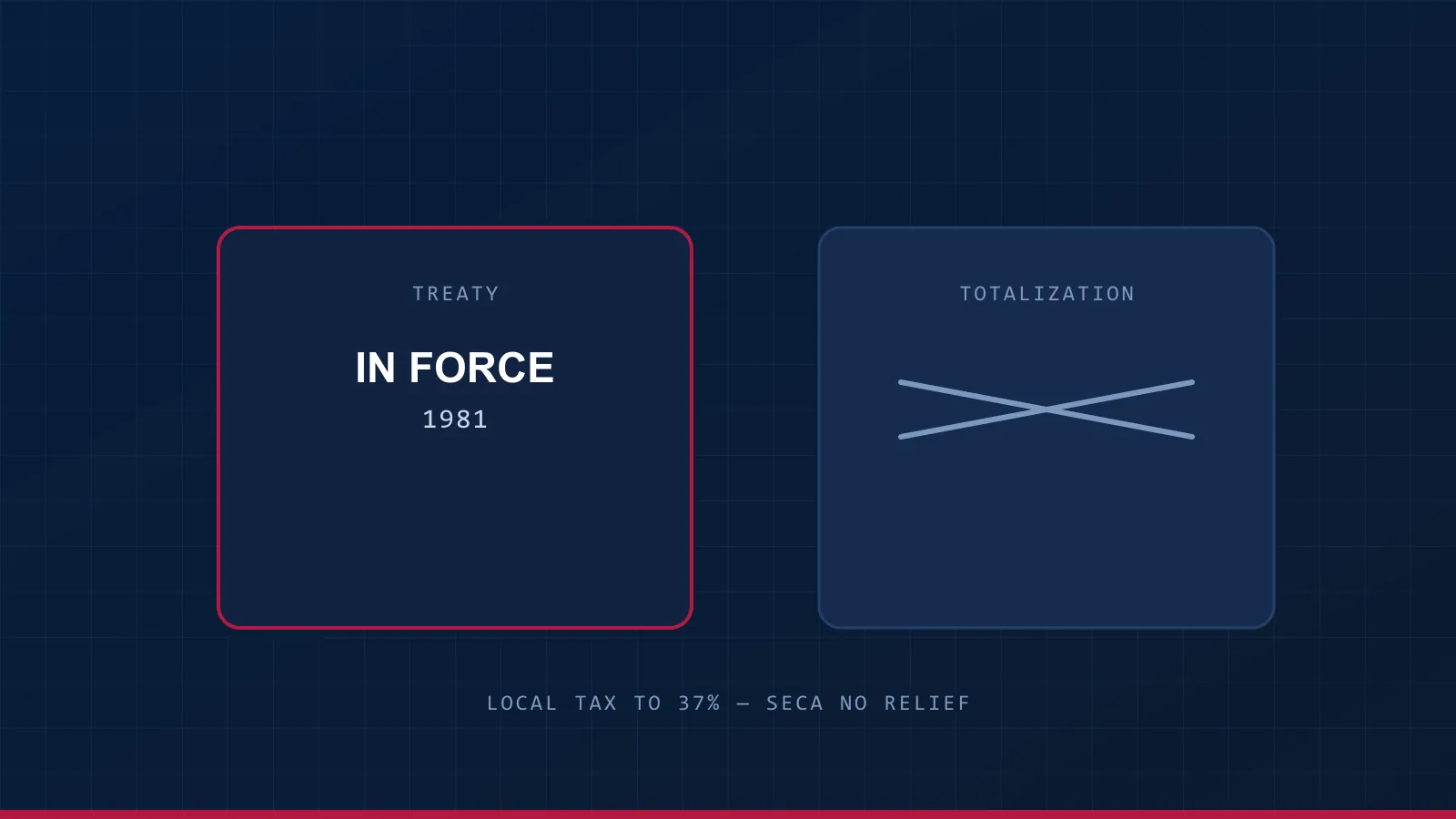

The treaty helps with income tax — not everything
Citizenship, not residence, decides who files a US return, so moving to Rabat, Casablanca or Marrakech does not pause it. The US–Morocco income tax treaty, signed in 1977 and in force since 1981, means Moroccan income tax actually paid is creditable against US tax on Form 1116 — double income tax is a solved problem here.
What the treaty does not reach is social security. There is no US–Morocco totalization agreement, so it settles nothing about self-employment tax — and that is where most of the cost lands for the freelancers and remote contractors who increasingly base themselves in Morocco.
Freelancers and remote workers: the self-employment trap
Morocco has become a popular base for Americans working remotely as freelancers or independent contractors — long-stay visas, lower living costs, and reliable connectivity make it an easy sell. What those arrangements do not change is US tax status: self-employment income brings Schedule SE onto the return, and with no totalization agreement to relieve it, the 15.3% self-employment tax applies to net earnings in full, regardless of what the Foreign Earned Income Exclusion does to the income tax side of the return.
At 37%, the credit usually beats the exclusion for employees
Morocco's progressive income tax reaches 37% for tax year 2026 — high enough that, for a salaried employee, the foreign tax credit alone frequently removes more US tax than the Foreign Earned Income Exclusion would. That is the opposite of the calculation in a no-tax Gulf state, and it is worth running on the actual salary and filing status rather than assumed from how the comparison usually goes elsewhere.
Real estate is common — know what is reportable and what is not
Morocco draws a steady stream of American retirees and long-stay residents who buy property outright. Real estate held directly is not itself reportable on the FBAR or Form 8938. Rental income is Schedule E, though, and the Moroccan bank account used to collect it counts toward the FBAR's $10,000 aggregate threshold like any other account.
A worked example, tax year 2025
A remote consultant based in Marrakech, single, qualifying under the physical presence test, paid as an independent contractor with no employer-provided housing.
Scroll the table sideways
IRC §911, §1401 and §1402; IRS Publication 54; IRS Publication 901; US–Morocco income tax treaty (1977, in force 1981); Social Security Administration totalization agreement list; IRS Streamlined Filing Compliance Procedures; Rev. Proc. 2025-32. Checked 20 September 2026.
Questions Americans in Morocco ask
Do I pay US self-employment tax on freelance work in Morocco?
Yes. There is no US–Morocco totalization agreement, so 15.3% self-employment tax applies to net self-employment income with no relief, regardless of what the Foreign Earned Income Exclusion does to income tax.
Does the treaty stop me being taxed twice on my Moroccan salary?
It addresses double income tax — Moroccan tax actually paid is creditable on Form 1116 — but the treaty dates from 1977, so its provisions are narrower than a modern treaty's. Check the actual article before relying on a specific position.
Should I claim the exclusion or the credit in Morocco?
For salaried employees, often the credit: Moroccan rates reach 37% for tax year 2026, high enough that the foreign tax credit alone frequently removes more US tax than the exclusion would. For freelancers, the exclusion still removes income tax — it just does nothing for the self-employment tax that sits underneath it.
I own an apartment in Morocco. Does that change my filing?
Directly held real estate is not itself reportable on the FBAR or Form 8938, but rental income is Schedule E, and the Moroccan bank account you use for it counts toward the FBAR's $10,000 aggregate threshold like any other account.
I have not filed for several years while in Morocco. What now?
If the failure was non-willful — which describes most people in this position — the Streamlined Foreign Offshore Procedures waive the failure-to-file, failure-to-pay and FBAR penalties: three years of returns, six years of FBARs, and Form 14653.
Freelancing or working remotely from Morocco?
Twenty minutes settles what the self-employment tax actually costs, and whether the credit beats the exclusion for your numbers.