US tax for Americans in Nepal
There is no US–Nepal income tax treaty and no totalization agreement. That does not remove the foreign tax credit — Form 1116 works on the statute — but it removes everything a treaty adds around it. Nepali rates reach 36%, and the larger risk for most Americans here is how their pay is characterised rather than how it is taxed.
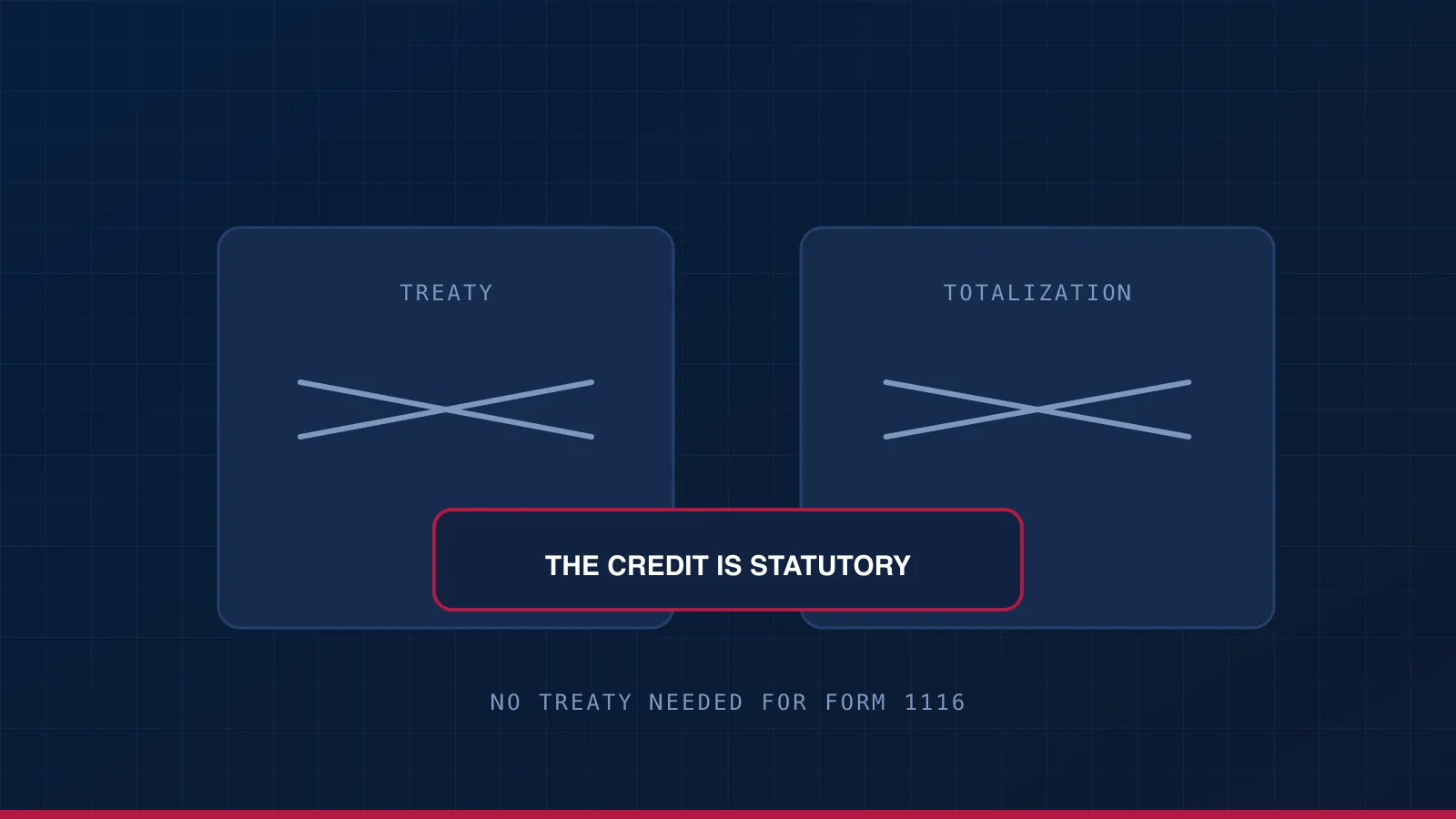

No treaty, and still a credit
The absence of a treaty does not remove the foreign tax credit. It is statutory: Nepali income tax actually paid is creditable against US tax on the same income under Form 1116, treaty or no treaty.
What is missing is everything a treaty adds around that — tie-breaker residence rules, pension articles, reduced withholding, and an exchange-of-information framework. The credit is the whole of the relief available.
How your pay is characterised is the real question
Many Americans in Nepal work for NGOs, mission organisations or trekking and tourism operations, and are paid in ways that read as self-employment for US purposes — support raised, stipends, honoraria, or contracts through an offshore entity.
That characterisation decides the 15.3% question, and with no totalization agreement there is nothing to relieve it. On $70,000 of net self-employment earnings that is close to $10,000 a year — usually the single largest line on a Nepali return, and one the income tax side never touches.
At 36%, the comparison is genuine
Nepali rates reach 36%, so on employment income the credit is often competitive with the exclusion. With no treaty, the comparison rests entirely on the statutory rules and on documenting the tax actually paid.
Keep the receipts
Without a treaty and its exchange-of-information machinery, substantiating a foreign tax credit falls entirely on your own records. Keep Nepali assessments and payment receipts — a credit you cannot evidence is a credit you may not keep.
A worked example, tax year 2025
A single American raising support for a mission organisation in Nepal, $70,000 of net self-employment earnings for the year.
Scroll the table sideways
IRC §901, §904, §911, §1401 and §1402; IRS Publication 54; IRS Publication 514; IRS Form 1116 instructions; Social Security Administration totalization agreement list; Rev. Proc. 2025-32; 31 CFR 1010.350. US figures are tax year 2025. Checked 22 September 2026.
Questions Americans in Nepal ask
Can I claim a foreign tax credit with no treaty?
Yes. The credit is statutory rather than treaty-based, so Nepali tax actually paid is creditable on Form 1116. What you lose without a treaty is the tie-breakers, pension articles and reduced withholding that sit around it.
I work for a mission organisation in Nepal. What is the main risk?
That your support or stipend is self-employment income for US purposes. With no totalization agreement, 15.3% SECA applies to net earnings — usually the largest single line on the return, and untouched by the exclusion.
Do Nepali rates make the credit or the exclusion better?
It is a genuine comparison: rates reach 36%, so the credit is often competitive on employment income. Without a treaty it rests on the statutory rules and on being able to document the tax you paid.
What records do I need to keep?
Nepali assessments and payment receipts, kept deliberately. With no treaty and no exchange-of-information framework behind it, substantiating the credit is entirely on your own records.
I have not filed for several years while in Nepal. What now?
If the failure was non-willful — which describes most people in this position — the Streamlined Foreign Offshore Procedures waive the failure-to-file, failure-to-pay and FBAR penalties: three years of returns, six years of FBARs, and Form 14653.
Working for a mission or NGO in Nepal?
Twenty minutes settles whether your support or stipend is self-employment for US purposes — which is where the cost actually is.