US tax for Americans in Oman
There is no US–Oman income tax treaty and no totalization agreement. Oman taxes no personal income today, so the Foreign Earned Income Exclusion and the foreign housing exclusion carry the return — but a 5% personal income tax takes effect on 1 January 2028, and it is the first thing in the Gulf that will produce a creditable foreign tax.
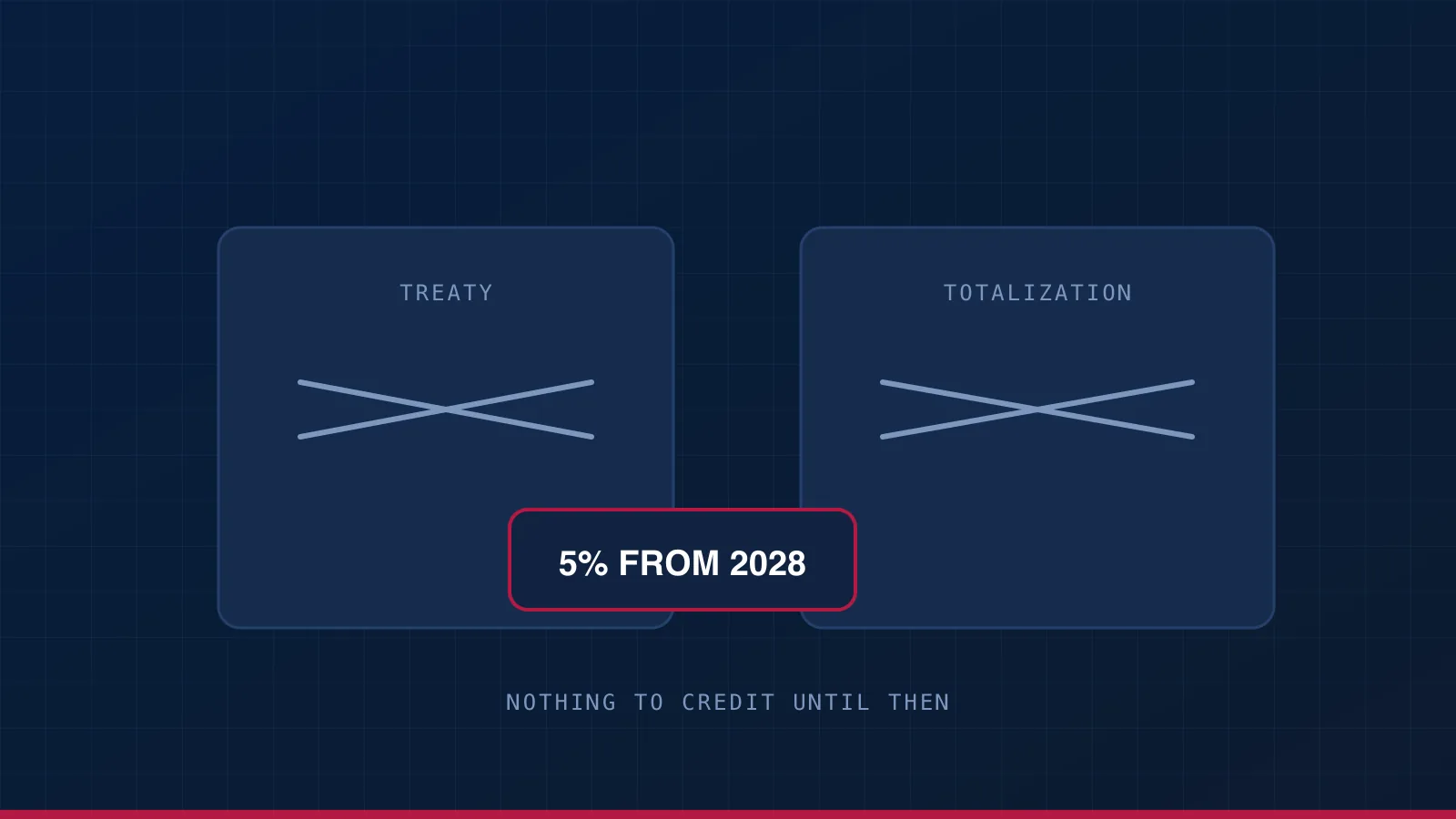

The position today: nothing to credit
Citizenship decides who files, so a posting to Muscat does not pause the US return. There is no US–Oman income tax treaty and no totalization agreement, and Oman levies no personal income tax on employment income today. The Foreign Earned Income Exclusion, $130,000 for tax year 2025, and the foreign housing exclusion on top of it are what the return runs on, with no foreign tax credit sitting behind them.
What changes on 1 January 2028
Oman issued its Personal Income Tax Law by Royal Decree No. 56/2025 in June 2025, the first of its kind in the Gulf. It applies a flat 5% to taxable income above OMR 42,000 a year — roughly $109,000 at the rial's pegged rate — and takes effect on 1 January 2028. Tax years 2026 and 2027 are unaffected.
For most Americans in Oman the threshold puts them outside it. For those above it, the arrival of a real Omani income tax means a creditable foreign tax exists for the first time, and the exclusion stops being the only tool on the return.
Why the decision you take now can bind you then
The exclusion and the foreign tax credit are a choice, and the choice is sticky in one direction: revoke the Foreign Earned Income Exclusion and you cannot claim it again for five tax years without IRS consent. A revocation made in 2026 therefore reaches into 2028 and beyond, which is exactly the window in which Oman's new tax starts producing credits.
That does not make either route right in the abstract. It makes the sequencing worth thinking about before a return is filed rather than after, particularly for high earners near the OMR 42,000 line.
Rotational and project contracts
Energy, construction and project work in Oman runs on rotations, and the physical presence test is unforgiving about them: 330 full days outside the United States across any rolling twelve months, with US days counting against you whatever brought you there. Where the count falls short, the bona fide residence test may still fit, but it asks about the nature of your residence rather than the tally.
Self-employment tax applies in full
With no totalization agreement, anyone invoicing for their own services pays 15.3% self-employment tax on net earnings, whatever the exclusion does to income tax. An employee on an Omani payroll does not have that exposure; a consultant on the same project frequently does.
A worked example, tax year 2025
An independent engineering consultant in Muscat, single, qualifying under the physical presence test, contracting directly with an operator.
Scroll the table sideways
IRC §901, §911, §1401 and §1402; IRS Publication 54; IRS Publication 514; IRS Form 2555 instructions on revoking the exclusion; Oman Royal Decree No. 56/2025 issuing the Personal Income Tax Law; Social Security Administration totalization agreement list; Rev. Proc. 2025-32; 31 CFR 1010.350. Figures are tax year 2025. Checked 22 September 2026.
Questions Americans in Oman ask
Is Oman introducing personal income tax?
Yes. Royal Decree No. 56/2025 issued a Personal Income Tax Law applying 5% to taxable income above OMR 42,000 a year, effective 1 January 2028. Tax years 2026 and 2027 are unaffected, so nothing on your current return changes yet.
Does a rotational contract keep me qualified?
Only if the days add up. The physical presence test needs 330 full days outside the United States in a rolling twelve months, and time at home counts against you whatever the reason. Where it falls short, the bona fide residence test is the alternative.
Should I switch from the exclusion to the foreign tax credit before 2028?
It is worth deciding deliberately rather than by default. Revoking the exclusion locks you out of it for five tax years without IRS consent, so a revocation now still binds you when Oman's tax starts. Which route wins depends on your income, your housing costs and how close you sit to the OMR 42,000 threshold.
Will the new Omani tax give me a foreign tax credit?
For income it actually taxes, yes — that is what changes in 2028. A 5% Omani income tax on income above the threshold is the sort of levy that can be credited against US tax on the same income, which is why the exclusion stops being the only tool on the return.
I have not filed for several years while in Oman. What now?
If the failure was non-willful — which describes most people in this position — the Streamlined Foreign Offshore Procedures waive the failure-to-file, failure-to-pay and FBAR penalties: three years of returns, six years of FBARs, and Form 14653.
Planning past 2028 in Oman?
Twenty minutes settles whether the exclusion still fits, and what revoking it would cost for five years.