US tax for Americans in Peru
Peru has no US income tax treaty and no totalization agreement. It taxes on domicile rather than residence: more than 183 days in any 12-month period puts a foreign national's worldwide income in its net, and someone outside it pays a flat 30% on Peruvian-source employment income. Peruvian tax is creditable on the US return, but with no treaty behind it and self-employment tax running at 15.3%.
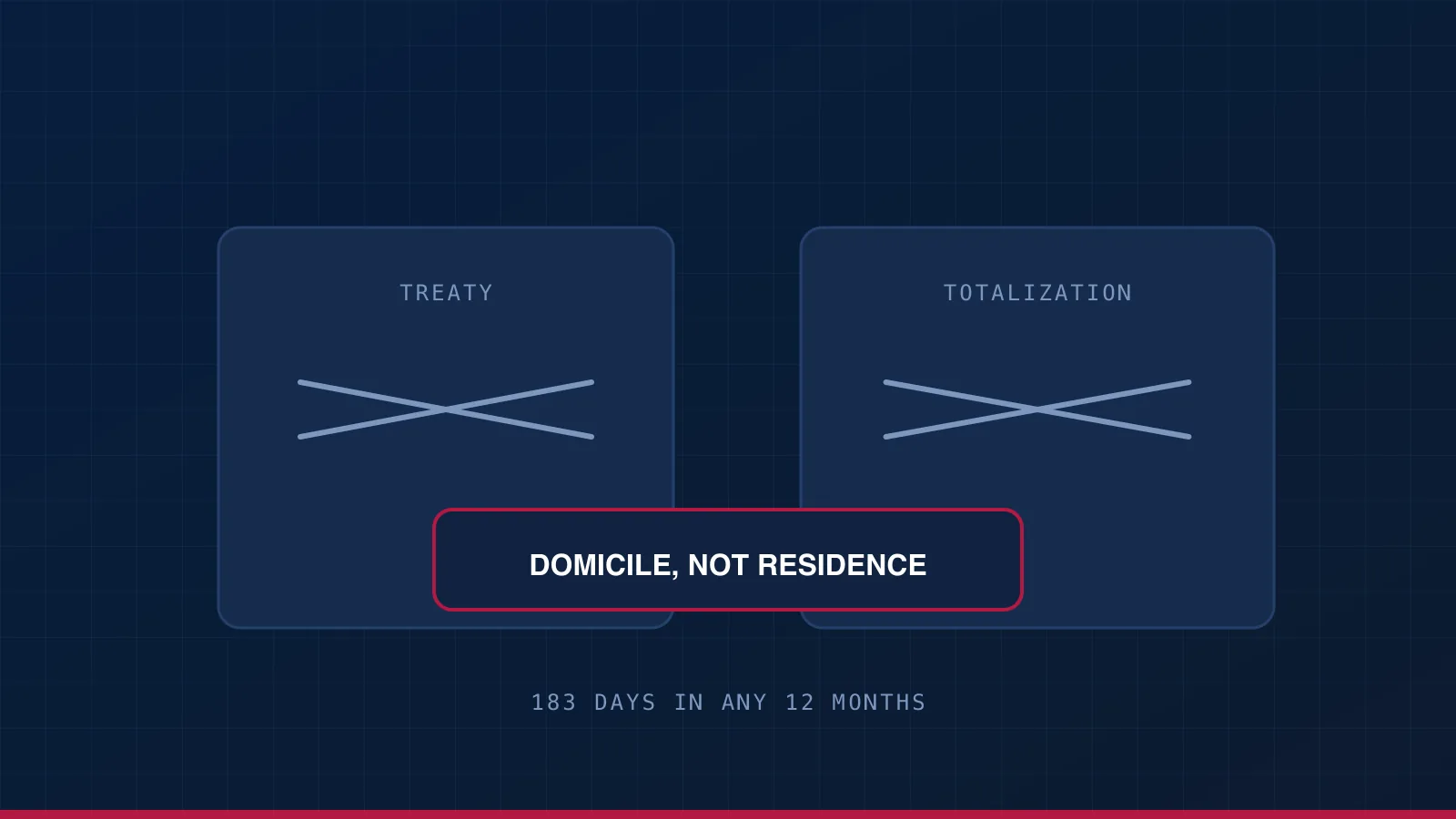

Domicile, not residence
Peruvian income tax follows domicile. A foreign national is domiciled once they have been in Peru for more than 183 calendar days within a 12-month period, and temporary absences within that period do not interrupt it. The count runs over any 12 months, not the calendar year.
The status is fixed at the start of the fiscal year, and a change during the year takes effect from 1 January of the next. A first partial year can sit on the non-domiciled side even after the 183rd day, which matters because what Peru taxes decides what there is to credit.
Two very different regimes
A domiciled individual is taxed on worldwide income on a five-bracket scale from 8% to 30%, measured in tax units. The 2026 unit is 5,500 soles, and the first seven units are exempt. A non-domiciled employee pays a flat 30% on gross Peruvian-source income, with no deductions and no credits.
Neither side is automatically better. A flat 30% on gross pay can exceed the progressive scale, and that Peruvian tax is creditable on the US return where it is actually paid.
No treaty, still a credit
Peruvian income tax is creditable on Form 1116 under the ordinary statutory rules, and Peru gives its own credit for tax paid abroad. What is missing is everything a treaty adds: a residency tie-breaker, a pension article, reduced withholding and a mutual agreement procedure.
Tax paid on income you exclude under the foreign earned income exclusion cannot also be credited. The choice between exclusion and credit is made on the numbers for each year.
Rents and share gains
Peru taxes income from leases and gains on shares at an effective 5% for domiciled individuals. The US taxes the same income at its own rates and limits the credit to the US tax on that income, so a low Peruvian rate leaves US tax to pay.
A worked example, tax year 2025
A single American consulting from Lima, $$85,000 of net self-employment earnings, with the 330-day test met. The US figures are computed.
| Net self-employment earnings | $85,000 |
| US income tax after the exclusion | $0 |
| Self-employment tax, no totalization agreement | $12,010 |
| Treaty relief available | None — there is no treaty |
| Peruvian income tax if domiciled | Creditable on Form 1116 where paid |
Scroll the table sideways
| Fact | Position |
|---|---|
| US income tax treaty | No |
| Totalization agreement | No |
| Local income tax | Progressive, 8% to 30% |
| Self-employment tax (SECA) | 15.3%, no relief |
| FBAR threshold | $10,000 aggregate, any point in the year |
IRC §901, §904, §911, §1401 and §1402; IRS Table 3 (List of Tax Treaties, updated through 26 September 2025); Social Security Administration totalization agreement list; IRS Publication 54; IRS Publication 514; IRS Form 8938 instructions; Peruvian domicile rules and the 2026 tax unit (PwC Worldwide Tax Summaries); Rev. Proc. 2025-32; 31 CFR 1010.350. US figures are tax year 2025. Checked 12 November 2026.
Questions Americans in Peru ask
Is there a US–Peru tax treaty?
No. The IRS list of treaties in force does not include Peru, and there is no totalization agreement either, so US self-employment tax applies at 15.3%.
Can I still credit Peruvian tax without a treaty?
Yes. The foreign tax credit comes from the Internal Revenue Code, so Peruvian income tax actually paid is creditable on Form 1116. What you lose is the treaty machinery.
When do I become domiciled in Peru for tax?
When you have been in Peru for more than 183 calendar days within a 12-month period. The status is set at the start of the fiscal year, so a change takes effect from 1 January of the next year.
What does Peru tax if I am not domiciled?
Only Peruvian-source income. An employee pays a flat 30% on gross Peruvian-source income, with no deductions or credits, which is why the date domicile starts is worth getting right.
I have not filed for several years while in Peru. What now?
If the failure was non-willful — which describes most people in this position — the Streamlined Foreign Offshore Procedures waive the failure-to-file, failure-to-pay and FBAR penalties: three years of returns, six years of FBARs, and Form 14653.
Filing from Peru?
Fifteen minutes settles when your Peruvian domicile began and whether the exclusion or a credit is the better route.