US tax for Americans in Taiwan
There is no US–Taiwan income tax treaty and no totalization agreement. Taiwanese income tax is progressive to 40% and creditable on Form 1116, but there is no treaty to allocate anything and no relief from US self-employment tax. Legislation that would provide double-tax relief has been under consideration in Congress rather than enacted as a treaty.
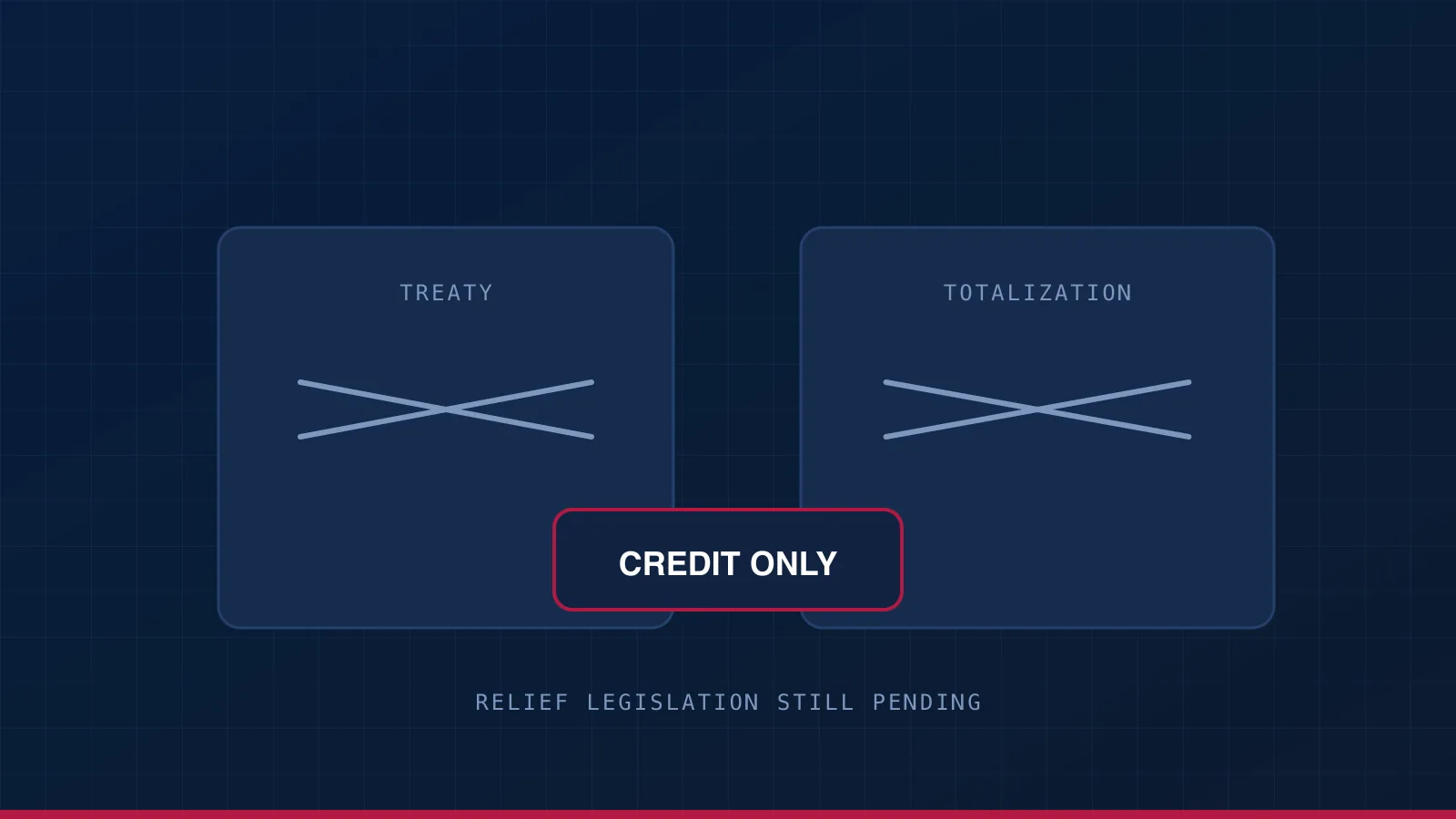

No treaty, and the credit does all of it
Without a treaty there is no article to allocate taxing rights, no reduced withholding rates and no tie-breaker for residence. What remains is the foreign tax credit: Taiwanese income tax actually paid, claimed on Form 1116 against US tax on the same income.
At a 40% top rate that is usually enough for a higher earner, and it generally beats the Foreign Earned Income Exclusion — which also keeps the income counted as compensation for retirement-account purposes, something the exclusion does not do.
Relief would arrive by legislation, not by treaty
Because the United States and Taiwan do not have diplomatic relations in the ordinary sense, double-tax relief has been pursued through legislation rather than a signed treaty. Its scope and start date are therefore not settled in the way a ratified treaty would settle them.
The practical position: plan on the current rules — credit only, no treaty — and treat any change as a reason to revisit a filed position rather than a reason to wait before filing. [TBD — confirm the status of the relief legislation before relying on it]
Equity is where the two systems diverge
Semiconductor and engineering postings in Taiwan routinely come with restricted stock or options, and that is where US and Taiwanese timing pull apart. The year each country treats a vesting event as taxable may not be the same year, and a credit is only useful in the year the matching income is taxed on the US side.
This is a timing problem rather than a rate problem, and it is solved with the vesting schedule on the table before the return is prepared — not afterwards, when the mismatch has already happened.
National Health Insurance is not a creditable tax
Premiums under Taiwan's National Health Insurance, including the supplementary premium charged on certain income, are insurance contributions rather than income taxes. They do not go on Form 1116, and with no totalization agreement they buy no relief from US self-employment tax either.
Self-employment tax applies in full
Anyone invoicing for their own services from Taiwan pays 15.3% US self-employment tax on net earnings, whatever Taiwanese tax has already been paid and whatever the credit does to the income tax side. An employee on a Taiwanese payroll does not have that exposure.
A worked example, tax year 2025
A single American engineer employed in Hsinchu on salary equivalent to $175,000, with Taiwanese income tax of $43,750 for the year, claiming the credit.
Scroll the table sideways
IRC §901, §904, §911, §1401 and §1402; IRS Publication 54; IRS Publication 514; IRS Form 1116 instructions; Social Security Administration totalization agreement list; Rev. Proc. 2025-32; 31 CFR 1010.350. US figures are tax year 2025. The status of US–Taiwan double-tax relief legislation should be confirmed before it is relied on. Checked 22 September 2026.
Questions Americans in Taiwan ask
Can I claim treaty benefits in Taiwan?
No. There is no US–Taiwan income tax treaty. You claim a foreign tax credit for Taiwanese tax actually paid. Double-tax relief legislation has been under consideration in Congress, but its scope and start date are not settled.
My equity vested in Taiwan. Which country taxes it first?
Both may, and often not in the same year. A credit only helps in the year the matching income is taxed on the US side, so the vesting schedule needs to be on the table before the return is prepared.
Are my National Health Insurance premiums creditable?
No. They are insurance contributions rather than income taxes, so they do not belong on Form 1116, and they do not relieve US self-employment tax.
Does self-employment tax apply if I contract from Taiwan?
Yes, in full. There is no totalization agreement, so 15.3% SECA applies to net self-employment earnings regardless of Taiwanese tax paid or the credit claimed for it.
I have not filed for several years while in Taiwan. What now?
If the failure was non-willful — which describes most people in this position — the Streamlined Foreign Offshore Procedures waive the failure-to-file, failure-to-pay and FBAR penalties: three years of returns, six years of FBARs, and Form 14653.
Posted to Taiwan with equity in the package?
Twenty minutes settles which year each country taxes a vesting event, and whether the credit lands where you need it.