US tax for Americans in the UK
There is a US–UK income tax treaty and a totalization agreement, so double income tax and double social security are both addressable, and UK rates are high enough that the foreign tax credit usually beats the exclusion. What neither instrument does is make a tax-free British wrapper tax-free in America — an ISA is fully taxable on the US return, and the funds inside one are usually PFICs.
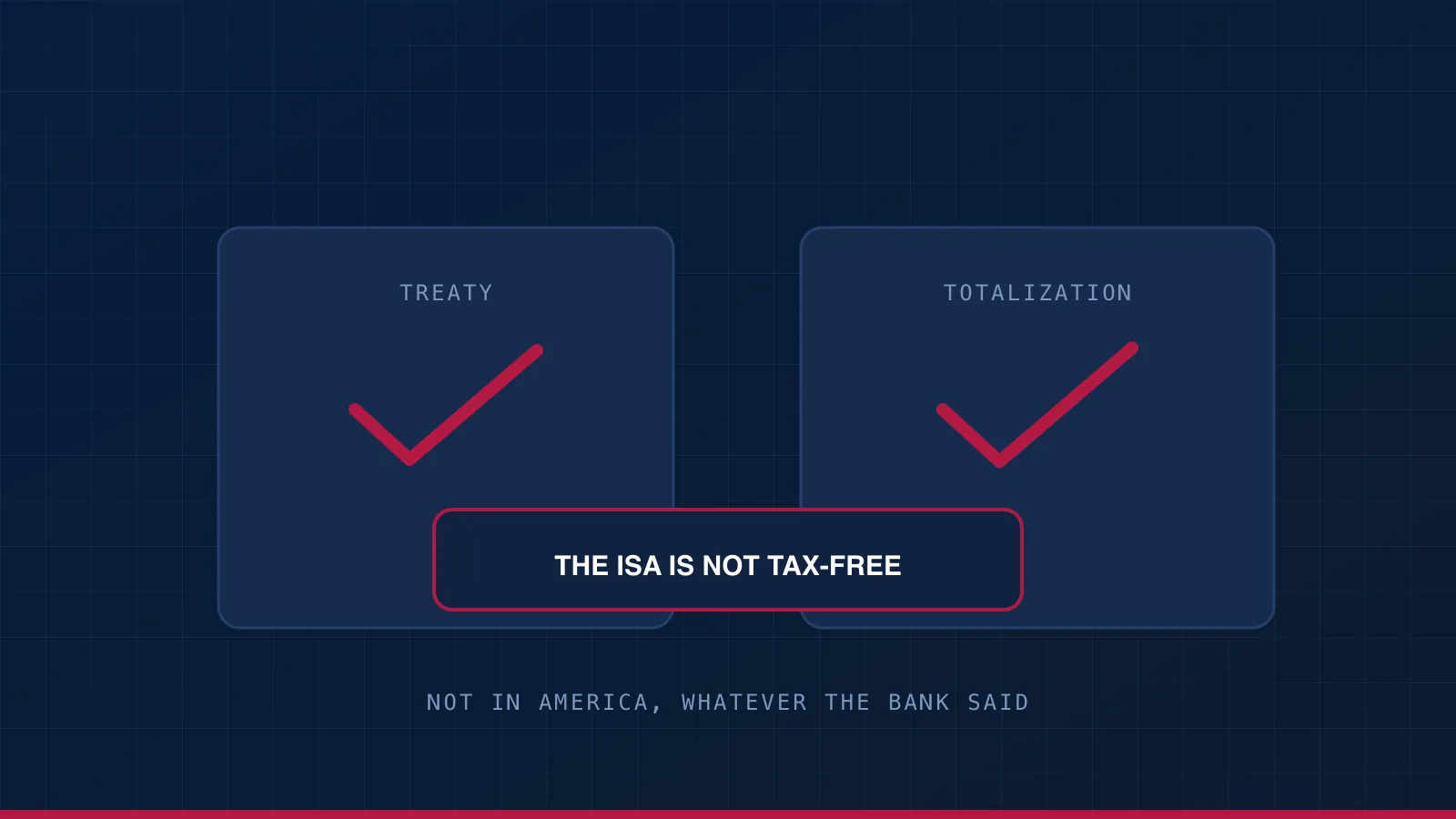

The treaty and the agreement each do one job
The US–UK income tax treaty addresses double income tax; the totalization agreement addresses double social security by assigning your coverage to one system. National Insurance sits inside the second of those, so a self-employed American paying Class 2 or Class 4 generally escapes the 15.3% US self-employment charge — evidenced by a certificate of coverage rather than assumed.
Neither instrument removes the filing obligation, and neither makes a British tax wrapper tax-free in America. That distinction is most of the work on a UK return.
The ISA is the single most expensive misunderstanding
Cash ISA interest is ordinary taxable interest to the US. The funds inside a stocks-and-shares ISA are worse: they are foreign mutual funds, which makes them passive foreign investment companies, which brings Form 8621 and a default calculation that taxes a disposal at the highest ordinary rate for every year the holding was owned, with an interest charge on top.
Nobody at the bank mentions this when the account is opened, and the wrapper that saves UK tax routinely becomes the most expensive line on the American return. It is the item unwound most often on UK files.
The 25% tax-free lump sum is a position, not a fact
The UK treats the pension commencement lump sum as tax-free. The US treatment is not settled, and turns on the treaty article relied on and how the scheme is structured. It is a position to take deliberately and document before the money is drawn — not to discover afterwards, when the choice has already been made for you.
Two tax years that do not line up
The UK tax year runs 6 April to 5 April; the US year is the calendar year. UK tax paid through PAYE therefore has to be apportioned across two US years, and whether you claim credits when the foreign tax is paid or when it accrues decides how that is done. The choice is effectively permanent, which makes the first UK return worth getting right.
The non-dom regime has gone
From 6 April 2025 the remittance basis was abolished and replaced by a four-year foreign income and gains regime for new arrivals, with a temporary repatriation facility for amounts that arose under the old rules. For a US citizen this changes the UK side of the position rather than the US one — the US has always taxed worldwide income — but it changes the UK tax paid, and therefore the credit available.
Anyone who arrived recently, or who claimed the remittance basis in earlier years, should have both sides looked at together rather than in isolation.
A worked example, tax year 2025
A single American employed in London on salary equivalent to $180,000, with UK income tax of $58,000 for the year, claiming the credit rather than the exclusion.
Scroll the table sideways
IRC §901, §904, §911 and §1291–1298; US–UK income tax treaty, including the pensions article; US–UK totalization agreement; IRS Publication 54; IRS Publication 514; IRS Form 8621 and Form 1116 instructions; HMRC guidance on the four-year foreign income and gains regime from 6 April 2025; Rev. Proc. 2025-32; 31 CFR 1010.350. US figures are tax year 2025. Checked 22 September 2026.
Questions Americans in the United Kingdom ask
Is my ISA tax-free on my US return?
No. The US does not recognise the wrapper. Interest and dividends inside it are taxable, and funds held inside a stocks-and-shares ISA are usually PFICs requiring Form 8621 and a harsher default calculation.
Is my 25% tax-free pension lump sum taxable in the US?
The UK treats it as tax-free; the US position is not settled and depends on the treaty article relied on and how the scheme is structured. It is a position to take deliberately and document before it is drawn, not after.
Is National Insurance creditable on Form 1116?
No — it is social security rather than an income tax, which is why the totalization agreement rather than the credit is what handles it. Where the agreement assigns your coverage to the UK, the US self-employment charge falls away on a certificate of coverage.
The UK tax year starts in April. How does that work with a US return?
By apportioning. UK tax paid through PAYE spans two US calendar years, and whether you claim credits when paid or when accrued decides how the split is handled. That choice is effectively permanent, so the first UK return matters more than the ones after it.
I have not filed for several years while in the UK. What now?
If the failure was non-willful — which describes most people in this position — the Streamlined Foreign Offshore Procedures waive the failure-to-file, failure-to-pay and FBAR penalties: three years of returns, six years of FBARs, and Form 14653.
Filing from the UK?
Twenty minutes settles what your ISA is doing to the return, and whether the credit or the exclusion fits your year.