US tax for Americans in Turkey
There is a US–Turkey income tax treaty, so Turkish income tax is creditable. There is no totalization agreement, so 15.3% US self-employment tax applies in full. What makes Turkish returns distinctive is the lira: income and foreign tax are both translated into dollars, and with a rapidly depreciating currency the translation is a real decision rather than a formality.
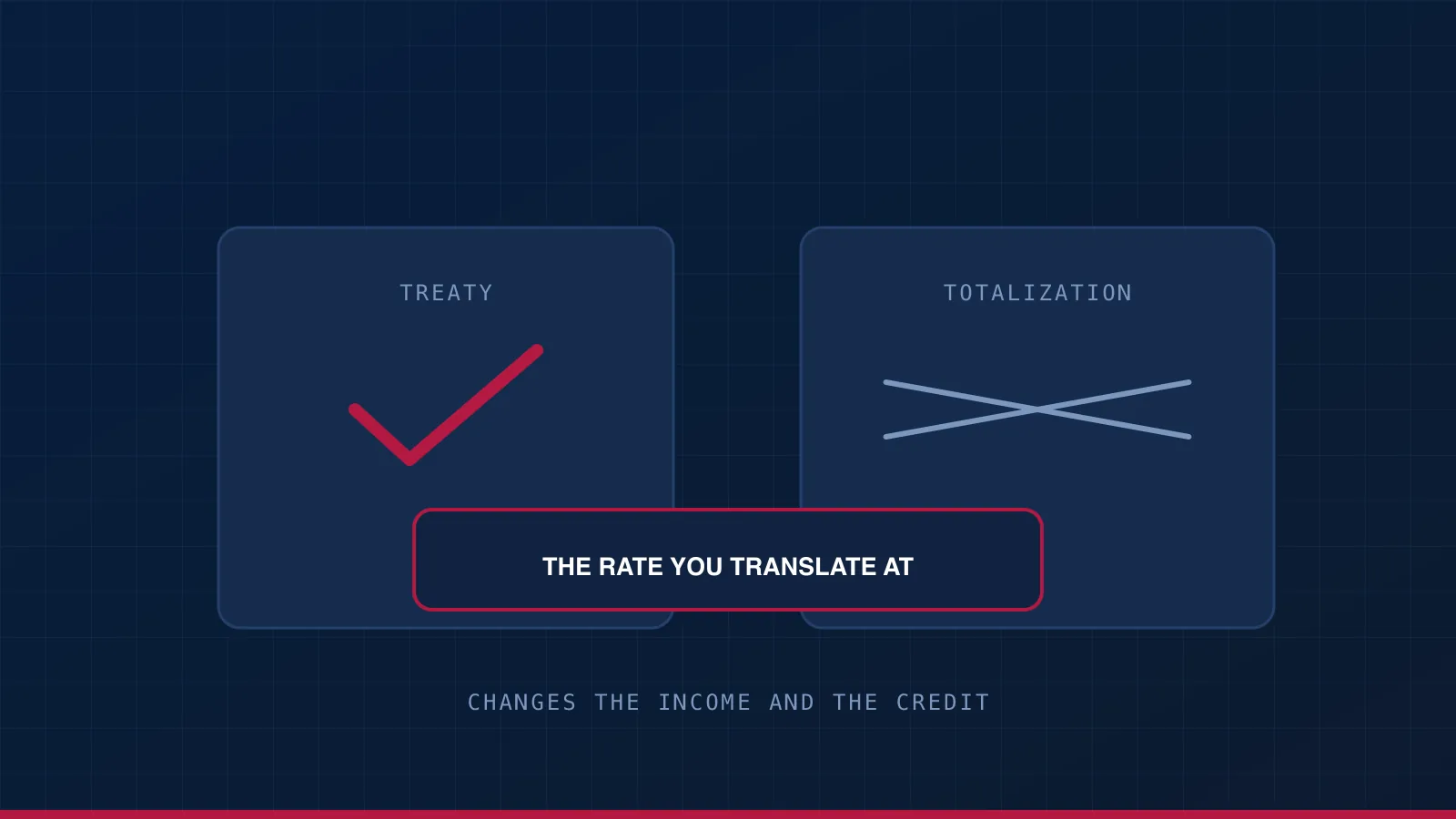

Translation is a decision, not a formality
Income and foreign tax paid are both translated into dollars for the US return. With a stable currency that is arithmetic. With a rapidly depreciating lira, the choice between an average rate for the year and the rate on the date each amount was paid can change the income reported and the credit claimed by a material margin.
The method has to be applied consistently and documented. Translating income at one basis and the tax at another — usually by accident — produces a figure that cannot be defended.
The treaty covers income tax and nothing else
Turkish income tax is creditable on Form 1116 and the treaty relieves double income tax. It does not reach social security, and there is no totalization agreement, so a consultant pays 15.3% self-employment tax on net earnings in addition to Turkish tax.
Consultants and remote workers make up a large share of the Americans in Istanbul, which makes that the most common US liability on a Turkish return.
SGK contributions credit nothing
Turkish social security contributions are not income taxes, so they do not belong on Form 1116 — and with no totalization agreement they buy no relief from the US self-employment charge either. They are a cost with no US offset on either side.
At 40%, the credit is usually competitive
Turkish rates reach 40%, so on employment income the credit generally beats the exclusion — subject to the translation question, which can move the creditable figure enough to change the conclusion in a volatile year.
A worked example, tax year 2025
A single American employed in Istanbul on the equivalent of $125,000, with Turkish income tax of $28,000 for the year, translated consistently at the yearly average rate. Turkish figures are illustrative; the US figures are computed.
Scroll the table sideways
IRC §901, §904, §911, §985–989, §1401 and §1402; US–Turkey income tax treaty; Social Security Administration totalization agreement list; IRS Publication 54; IRS Publication 514; IRS guidance on foreign currency translation; Turkish income tax and SGK contributions; Rev. Proc. 2025-32; 31 CFR 1010.350. US figures are tax year 2025. Checked 22 September 2026.
Questions Americans in Turkey ask
Which exchange rate do I use for Turkish income?
Either a yearly average rate or the rate on the date each amount was received or paid, applied consistently to income and to the tax. With a rapidly moving lira the choice materially changes the reported income and the credit, so it is documented rather than assumed.
Do I pay US self-employment tax in Turkey?
Yes, in full, if the work is self-employment for US purposes. There is no totalization agreement, so 15.3% SECA applies to net earnings whatever the treaty does to income tax.
Are SGK contributions creditable?
No. They are social security rather than income tax, so they do not go on Form 1116 — and with no totalization agreement they relieve nothing on the self-employment side either.
Is the credit or the exclusion better in Turkey?
Usually the credit, because rates reach 40%. In a volatile currency year the translation can move the creditable figure enough to change the answer, so it is worth computing rather than assuming.
I have not filed for several years while in Turkey. What now?
If the failure was non-willful — which describes most people in this position — the Streamlined Foreign Offshore Procedures waive the failure-to-file, failure-to-pay and FBAR penalties: three years of returns, six years of FBARs, and Form 14653.
Filing from Istanbul?
Twenty minutes settles the translation method and whether your arrangement is self-employment for US purposes.