Do you pay US tax on a property you own abroad?
Owning it, no. Renting it or selling it, yes. Foreign rent is US taxable income in the year you receive it, and a sale is measured in US dollars rather than in the local currency — which means a house that sold for exactly what it cost can still show a taxable gain on your return. The house itself is not an FBAR or Form 8938 item. The bank account the rent lands in usually is.
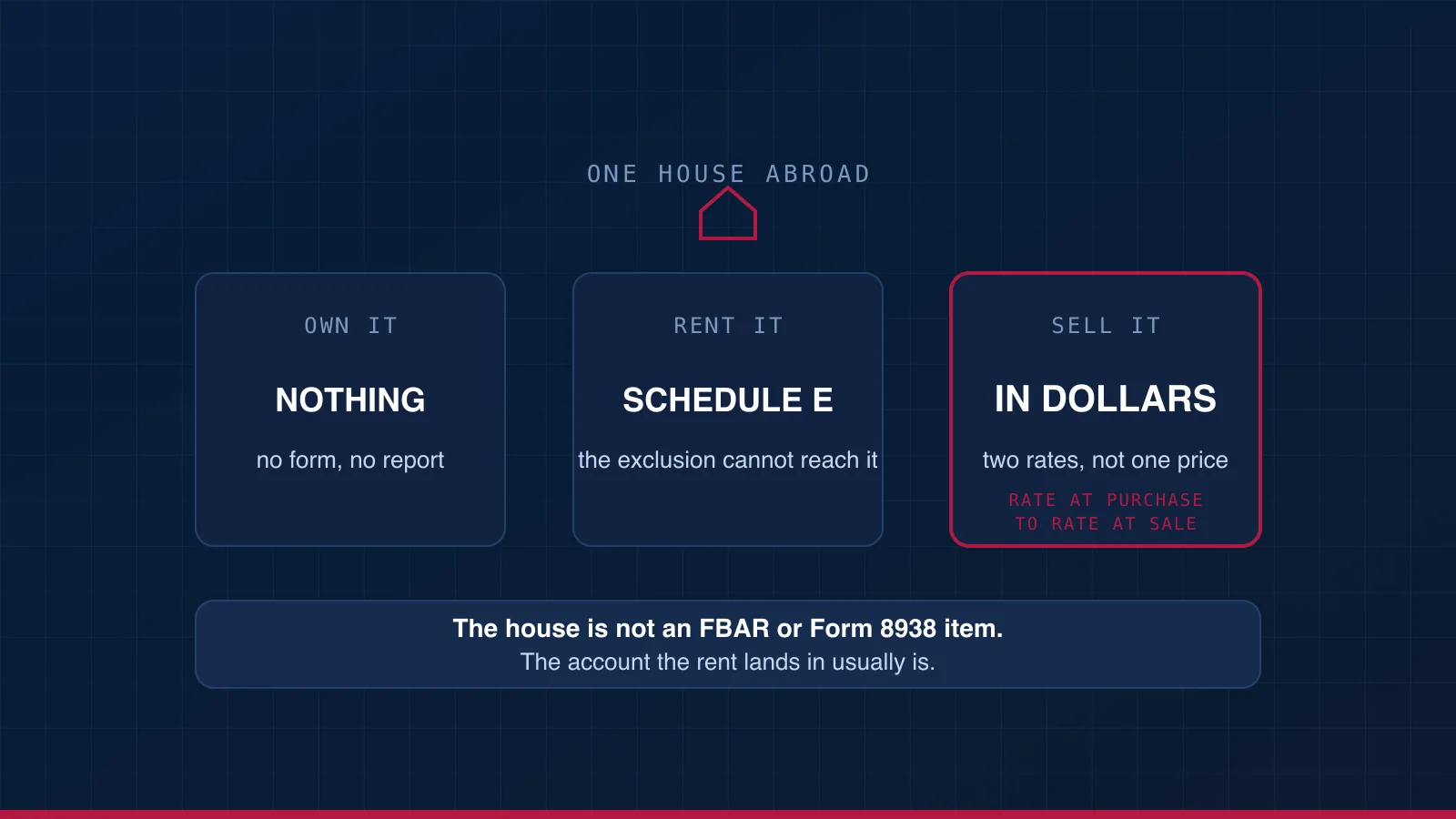

Rent is reported, even when no US tax is due
A US citizen is taxed on worldwide income, and rent from a flat in Lisbon is worldwide income in exactly the way rent from a flat in Ohio is. It goes on Schedule E, in US dollars, in the year you receive it. It does not matter that the tenant pays in euros, that the money never leaves the country, or that Portugal has already taxed it.
What usually stops a second tax being charged is the foreign tax credit on Form 1116, not the exclusion. Rental income is normally passive category income for that form, so the foreign tax on the rent is credited against the US tax on the same income. The exception worth knowing is that rents derived in the active conduct of a trade or business sit in the general category instead, which changes the basket the credit lands in.
The Foreign Earned Income Exclusion does nothing here. It reaches earned income — wages and self-employment income — and rent is not earned income. Neither is a capital gain. That is the single most common misunderstanding about property abroad: the relief most expats rely on for their salary does not touch their rental income at all. The same distinction decides whether you can fund an IRA, for the same reason.
Depreciation on a foreign rental runs on a longer clock
US rules require depreciation on residential rental property whether or not you claim it, and the gain on an eventual sale is calculated as though you had. Property used predominantly outside the United States has to be depreciated under the Alternative Depreciation System, which is straight line over a longer recovery period than the domestic default.
For residential rental property the ADS recovery period is 30 years if the property was placed in service after 31 December 2017, and 40 years if it was placed in service before that. Only the building depreciates; the land does not. The practical effect is a smaller annual deduction than a US rental of the same value would produce, and a longer tail of depreciation to account for when the property is sold.
A sale is measured in dollars, not in the local currency
This is the part that surprises people. Your gain is not the local-currency difference between what you paid and what you sold for. It is the dollar difference. The IRS instruction is to translate a foreign currency item at the exchange rate prevailing when you receive, pay or accrue it, so the purchase price is translated at the rate on the day you bought and the sale proceeds at the rate on the day you sold.
Two consequences follow. A property that sold for exactly its purchase price in local currency can produce a taxable dollar gain, if the currency strengthened against the dollar in between. And a property that made a local-currency profit can produce a dollar loss, which on a main home is not deductible at all.
The main home exclusion under section 121 is available on a home abroad. Nothing in it requires the property to be in the United States: if you owned the home and lived in it as your main home for at least 24 months out of the 5 years before the sale, you can exclude up to $250,000 of gain, or $500,000 on a joint return. Two limits matter for expats in particular. Gain equal to depreciation allowed or allowable after 6 May 1997 cannot be excluded, so a home you rented out for a period keeps that much in the taxable column. And periods after 2008 when the property was not your principal residence are nonqualified use, with gain allocated to them generally not excludable.
If section 121 does not cover the gain, the 3.8% Net Investment Income Tax can apply on top, since rental income and capital gain are both net investment income. It bites above modified adjusted gross income of $200,000 for a single filer and $250,000 on a joint return, and for expats it has a sharp edge: the foreign earned income you excluded is added back in working out that income, and foreign tax credits cannot be used against this tax. A foreign tax that wipes out the income tax can leave the 3.8% standing.
What the house is, and is not, reportable on
Foreign real estate held directly, in your own name, is not reportable on the FBAR and not a specified foreign financial asset on Form 8938. A personal residence or a rental property does not go on either form. Foreign currency held directly is outside both as well.
What is reportable is the financial plumbing around the property. The account the rent is paid into, or the account holding the sale proceeds, counts towards the FBAR threshold of $10,000 in aggregate at any point in the calendar year. And if you hold the property through a foreign company, partnership or trust rather than in your own name, the thing you own is an interest in a foreign entity, which is a specified foreign financial asset — the entity goes on Form 8938, valued with the real estate inside it, once you cross the threshold. Living abroad, that threshold is $200,000 at year end or $300,000 at any time for a single filer, and $400,000 or $600,000 filing jointly. Which of those forms you actually owe is the subject of the FBAR and FATCA compliance page.
The foreign mortgage, and where the rule gets genuinely unsettled
A mortgage denominated in a foreign currency is a separate asset from the house, and it moves on its own. Becoming the obligor under a debt instrument is a section 988 transaction, and foreign currency gain or loss on a section 988 transaction is computed separately from the underlying property and treated as ordinary income or loss — never capital gain, however long the house was held.
The mechanism is simple enough. You borrow €200,000 when the euro costs $1.10, which is $220,000 of borrowing. You repay €200,000 when the euro costs $1.02, which is $204,000. You discharged a $220,000 obligation for $204,000, and that $16,000 difference is an exchange gain. It can arise on a sale, on an early payoff, and on a refinance, because a refinance discharges the old loan even though the house has not moved.
Where this stops being clear is the personal residence. Section 988 contains a carve-out: its provisions do not apply to a section 988 transaction entered into by an individual which is a personal transaction, and a personal transaction is one where the expenses would not be deductible under section 162 or section 212. A mortgage on a rental property is not a personal transaction, so section 988 plainly applies and the exchange gain is ordinary income. A mortgage on your own home looks like a personal transaction, which would switch section 988 off — but that does not clearly mean the gain disappears, and practitioners do not agree on what fills the gap. If you are paying off or refinancing a foreign mortgage on a home you live in, this is worth deciding deliberately rather than by default, and it is the kind of question advice is actually for.
A worked example, tax year 2026
One flat in the eurozone, bought in 2018 for €300,000 and sold in tax year 2026 for €300,000 — not a cent of local-currency gain. The euro is assumed to cost $1.10 at purchase and $1.18 at sale. Column A lived in it throughout as a main home; column B rented it out for the whole eight years, depreciating the building under the 30-year ADS period.
Scroll the table sideways
IRC §121, §168(g)(1)(A), §911(b)(1), §988 and §1411; Treas. Reg. §1.1411-1(e); IRS Publication 523 on the main home exclusion, depreciation recapture and nonqualified use; IRS Publication 527, Table 2-1, for the ADS recovery periods; IRS Publication 54 on what is not foreign earned income; IRS Form 1116 instructions on passive category income; IRS guidance on foreign currency and currency exchange rates; the IRS Form 8938 questions and answers and its FBAR comparison, for directly held real estate and the thresholds; IRS Net Investment Income Tax guidance for the 3.8% rate. Figures are stated for tax year 2026. Checked 7 October 2026.
Questions about foreign property
Do I have to report rent from a property I own abroad?
Yes. A US citizen reports worldwide income, so foreign rent goes on Schedule E in US dollars whether or not the money ever reaches the US and whether or not the other country taxes it. Foreign tax paid on that rent is usually creditable on Form 1116, which often reduces the US tax to nothing — but the return still has to be filed.
Does the Foreign Earned Income Exclusion cover my rental income or my gain on sale?
No. The exclusion only reaches earned income — wages and self-employment income. Rent and capital gain are not earned income, so the exclusion does nothing for either. The foreign tax credit is the relief that applies to them.
Do I report my foreign house on the FBAR or Form 8938?
Not if you hold it directly. Foreign real estate held in your own name is not a financial account and not a specified foreign financial asset. What can be reportable is what sits around it: a foreign bank account holding the rent crosses the FBAR at $10,000, and if you hold the property through a foreign company or trust, the interest in that entity is reportable on Form 8938.
Can I use the $250,000 main home exclusion on a house abroad?
Yes, if you meet the ownership and use tests — owned and lived in it as your main home for at least 24 months of the 5 years before the sale. Nothing in section 121 requires the home to be in the United States. The exclusion is $250,000, or $500,000 on a joint return, and it does not cover gain equal to depreciation you took while renting it out.
The local price never changed, so why does my US return show a gain?
Because the gain is computed in dollars. Your basis is translated at the exchange rate when you bought and the proceeds at the rate when you sold, so a currency that moved against the dollar across those years can produce a taxable dollar gain on a sale that broke even locally. The same arithmetic can produce a dollar loss on a local-currency profit.
Bought, rented or sold a property abroad?
Fifteen minutes, free, with me rather than a salesperson — enough to say which forms your situation actually needs and what the sale year looks like.