US taxes with a foreign spouse: should you file jointly, separately or as head of household?
US taxes with a foreign spouse come down to a choice of filing status. If your spouse is not a US citizen or resident, you can file separately, which needs no election; file jointly, by electing to treat your spouse as a US resident; or file as head of household if you have a qualifying person other than your spouse. The right one depends mostly on your spouse's income and assets, because the joint election brings all of it into your US return — and once it ends, it cannot be made again.
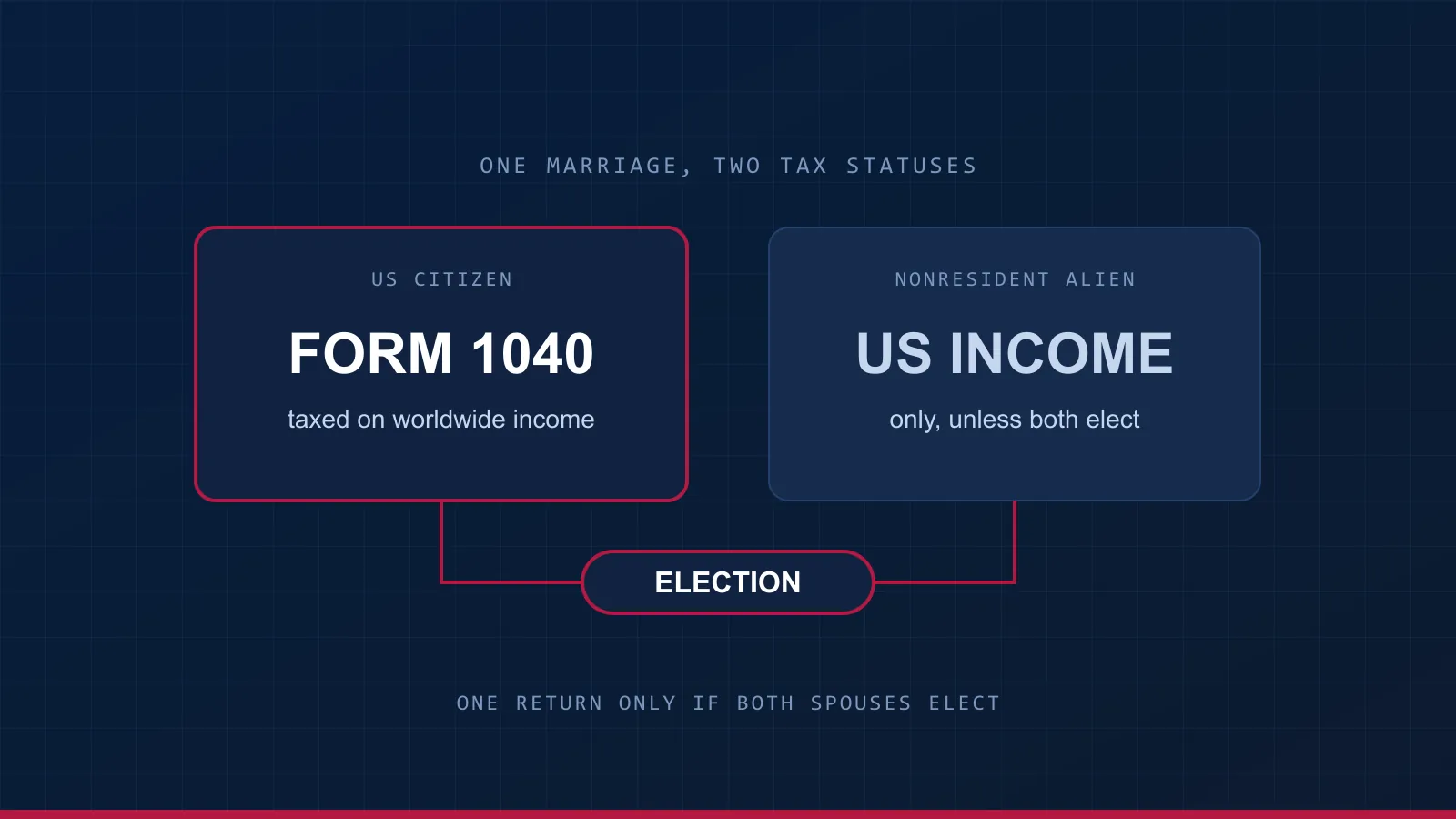

Your spouse's tax status decides everything
The rules turn on one question: at the end of the year, is your spouse a nonresident alien for US tax purposes? A spouse who is neither a US citizen nor a green card holder, and who does not meet the substantial presence test, is a nonresident alien. That stays true if you have been married for decades and live together in their country. A spouse who holds a green card, or who meets the substantial presence test, is a resident alien and files with you the way any US couple does.
This article is about the nonresident case, which is the common one for Americans abroad. A related election under §6013(h) covers the year a spouse becomes a US resident partway through; it works differently and is not covered here.
Your three options
A US citizen married to a nonresident alien can choose between separate filing, joint filing with an election, and head of household. The figures below are for tax year 2026.
Married filing separately, the default
With no election, you file separately. The return reports your income and your deductions, and your spouse is not part of the calculation. The form still asks for your spouse's name; if they have no SSN or ITIN and are not required to have one, you enter "NRA" there instead. The standard deduction is $16,100. Your spouse generally files nothing in the US unless they have US income of their own, in which case that is a separate Form 1040-NR.
Separate filing is also the flexible option, since you choose again every year. It is not free of cost, though, and the traps below fall mostly on separate filers.
Married filing jointly with the 6013(g) election
You and your spouse can choose to treat your spouse as a US resident for tax purposes. Both of you must make the choice, and it is what allows a joint return. The standard deduction rises to $32,200, and joint rates apply.
The election is made by attaching a statement to a joint return for the first year it is to apply. The statement carries each spouse's name, address and taxpayer identification number, a declaration that you are electing, and both signatures. If your spouse has no SSN, they apply for an ITIN on Form W-7.
Head of household, when you are "considered unmarried"
For head of household purposes you are considered unmarried if your spouse was a nonresident alien at any time during the year and you did not elect to treat them as a resident. Your spouse cannot be the qualifying person, so you need someone else: generally a child or other relative you can claim who lived in your home for more than half the year, or a parent you can claim and for whom you pay more than half the cost of keeping up their home. You must also pay more than half the cost of keeping up your own home.
The standard deduction is $24,150, between the other two. Choosing the joint election gives this status up, because the election requires a joint return.
What the joint election costs you
The election is not a free upgrade to the larger standard deduction. Four things come with it.
Your spouse's worldwide income joins your return. For every year the election is in effect, income from every source is included, not only US income.
Your spouse loses the treaty argument. While the election is in effect, neither of you can claim under an income tax treaty that your spouse is not a US resident.
Their foreign assets come into Form 8938. The form's instructions treat a nonresident alien who elects to be treated as a resident for a joint return as a specified individual, so their own foreign financial assets are counted. Filing separately keeps them off your forms, although an account you hold jointly counts in full on yours either way.
It continues, and it cannot be made again. The election applies to the year you make it and every later year until it ends. Once it has ended, you cannot make it again.
The earned income exclusion for a couple
Your own exclusion works the same under any of the three statuses: up to $132,900 for tax year 2026 if you pass the physical presence or bona fide residence test. Whether your spouse's own earnings can also be excluded after the election depends on which residence test they can meet, so it is worth settling before you elect, because the answer decides whether their income is taxed here at all.
Foreign tax your spouse pays on that income can often be credited on Form 1116 once it is included on a joint return, which is the usual relief where the exclusion does not apply.
Traps for couples abroad
Social Security. If you file separately and lived with your spouse at any point in the year, the base amount for taxing Social Security benefits is $0, so up to 85% can be taxable from the first dollar. The retirees abroad page covers it.
Roth IRAs. Filing separately while living together limits a Roth contribution to an income phase-out of $0 to $10,000 for tax year 2026.
Spousal IRAs. A spouse with no income can be funded from your compensation only on a joint return, and only if your pay is not entirely excluded. Both points are explained in can you contribute to an IRA while living abroad?
Joint accounts. An account you hold with your spouse is reportable by you in full on the FBAR whichever status you choose. The FBAR page lists which accounts count.
A worked comparison, tax year 2026
Take a US citizen abroad and a nonresident alien spouse with no US filing requirement of their own. The table sets out what each status does. It does not compute a tax bill, because that depends on both incomes.
The joint election's main attraction is arithmetic: it lifts your standard deduction from $16,100 to $32,200. That extra $16,100 is worth $1,932 at a 12% marginal rate and $3,542 at 22%. If your spouse has no income, there is nothing to add to the joint return, so the election costs you little in tax and mostly adds reporting and permanence. If your spouse earns, say, $60,000 locally, the same election adds that $60,000 to your return, and the question becomes whether the foreign tax paid on it, credited on Form 1116, covers the US tax. Where it does not, separate returns can come out ahead. Run both before choosing.
Scroll the table sideways
How the election ends
Once made, the election applies to that year and every later year. It ends in four ways: either spouse revokes it, effective for the first year whose return is not yet due; either spouse dies; you divorce or legally separate by decree; or the IRS ends it because a spouse failed to keep adequate records. After it ends, you cannot make it again.
The decision is worth modelling before the first joint return, not after. If your return is on extension, the choice is still open: it is made on the joint return itself. Whether a decision like this is worth paying for advice on is covered in do you need a US expat tax advisor?
IRC §6013(g) and (h), §86 and §408A; Treas. Reg. §1.6013-6; IRS Publication 519; IRS Publication 501; IRS Form 1040 and Form 8938 instructions; IRS, "US citizens and residents abroad: head of household"; Rev. Proc. 2025-32 for the 2026 standard deductions and exclusion; IRS Notice 2025-67 for the 2026 Roth limits. Figures are stated for tax year 2026. Checked 11 October 2026.
Questions about US taxes with a foreign spouse
Do I have to include my foreign spouse on my US tax return?
Not in the tax calculation, unless you elect joint filing. On a separate return the form still asks for your spouse's name, and if they have no SSN or ITIN and are not required to have one, you enter "NRA" there. Electing joint filing puts your spouse in the calculation and makes their worldwide income reportable.
Should I file jointly or separately if my spouse is not a US citizen?
It depends mainly on your spouse's income and assets. If they have little or none, the joint election costs little in tax and gives you the larger standard deduction — $32,200 against $16,100 for tax year 2026. If they have meaningful income or assets, the election brings all of it into your US return, so run both before choosing, and remember that the election cannot be made again once it has ended.
Does my foreign spouse need an SSN or ITIN?
For a joint return, yes: each spouse's taxpayer identification number goes on the election statement, and a spouse with no SSN applies for an ITIN on Form W-7. On a separate return they need neither, unless they have a US filing requirement of their own.
Will my spouse's foreign income be taxed by the US if we file jointly?
Yes. While the election is in effect, your spouse's worldwide income is included on your joint return, whether or not any of it comes from the US. Foreign tax paid on it can often be credited on Form 1116, and their earned income may qualify for the exclusion depending on the residence test they meet, so the net result can still be low, but the income is reportable.
Can I file as head of household if my spouse is a nonresident alien?
Possibly. You are considered unmarried for head of household purposes if your spouse was a nonresident alien at any time during the year and you did not elect to treat them as a resident. Your spouse cannot be your qualifying person, so you need someone else, such as a child who lived with you for more than half the year, and you must pay more than half the cost of keeping up your home. The 2026 standard deduction is $24,150.
Not sure which status fits your marriage?
Bring last year's return and your spouse's income and account details. Fifteen minutes is enough to tell you which of the three to model first.