Who qualifies for the Streamlined filing procedures?
If you live abroad and are years behind on US filings, three conditions decide whether the Streamlined Foreign Offshore Procedures are open to you: the miss was non-willful, you spent at least 330 full days outside the US in one of the last three years, and the IRS has not opened an examination. Each has a precise meaning, and the 330-day count is the one people get wrong.
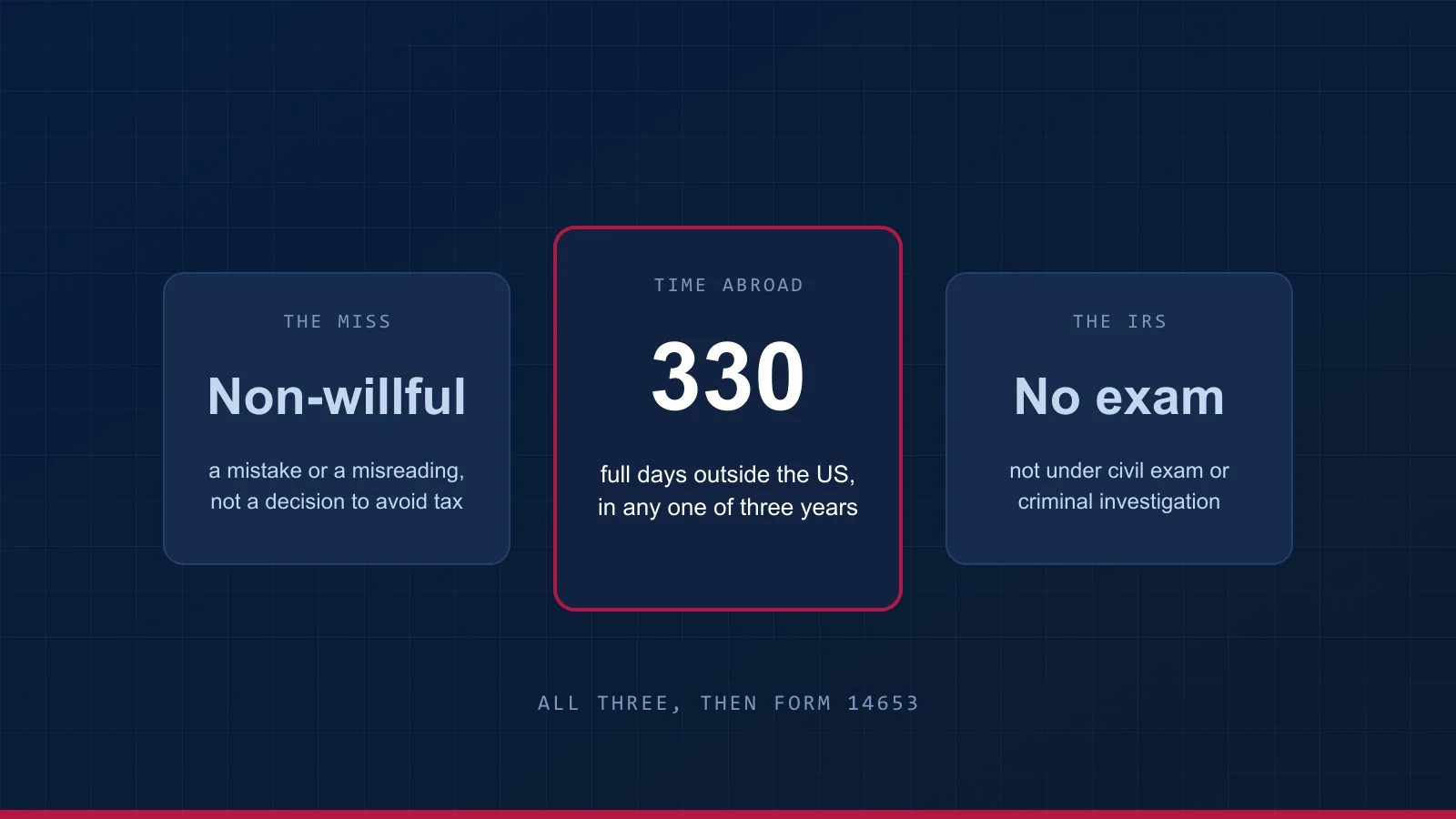

The three conditions
The procedures are for US citizens and green card holders, and for estates, who failed to file returns, report income, pay tax or file information returns such as the FBAR. All three of the following have to be true.
Counting the 330 days
The test looks at one year, not all three. Take the most recent three tax years whose due date has passed, extensions included. If in any one of them you had no US abode and were outside the US for at least 330 full days, you meet it. The returns you then file still cover all three years.
A full day runs midnight to midnight, so the day you land and the day you leave do not count as days abroad. Out of 365, that leaves room for about 35 days that are not full days outside the US. A teacher who spends a month at home each summer still clears it. One who spends the whole summer there, eight weeks or more, does not in that year, though another of the three years may.
Abode is a separate question from days. The IRS says that being in the US temporarily, or keeping a dwelling there, does not necessarily put your abode there. It is judged on where your life is centred, using the meaning in IRS Publication 54.
The same 330-day count appears in the physical presence test for the Foreign Earned Income Exclusion, but this is a separate test with a different purpose. Passing one does not depend on claiming the other.
What non-willful means, and what it does not
Non-willful conduct is a failure caused by negligence, inadvertence, a mistake, or a good-faith misunderstanding of what the law required. Not knowing that US citizens abroad file every year, or assuming that tax paid abroad ended the obligation, are the usual examples.
It is not a presumption. You certify it yourself, in your own words, on Form 14653, and the statement has to be supportable. A willful miss is a decision to avoid US tax or to hide an account. That case is outside these procedures and belongs with a tax attorney. If you are unsure which side of the line your facts fall on, that is the first thing to settle, before anything is filed.
Married filers, and the smaller conditions
On a joint return, both spouses must meet the non-residency requirement. Every return has to carry a valid taxpayer identification number, and someone without one sends an ITIN application with the returns. You also need to be willing to comply for future years, since the relief covers only the years you file.
What you file once you qualify
Three years of returns, Form 1040 or the amended Form 1040-X, with any information returns the facts require, such as Forms 3520, 5471 and 8938. Six years of FBARs. And Form 14653, the signed statement that you are eligible, that the FBARs are filed, and that the miss was non-willful.
The returns go in on paper, marked "Streamlined Foreign Offshore" in red at the top of the first page. The FBARs are filed electronically with FinCEN, with an explanation that they are part of the procedures. All tax due and interest is paid with the submission. A missing or incomplete statement means the returns are processed as ordinary late returns, without the relief.
For a filer who qualifies, the failure-to-file, failure-to-pay, accuracy-related, information-return and FBAR penalties are not charged. Penalties already assessed for those years are not removed, and the relief falls away if an examination finds the original non-compliance was fraudulent or the FBAR violation willful.
If one of the conditions fails
Under examination, or the miss was willful. These procedures are closed, and the next conversation should be with a tax attorney, not a preparer. If that is you, I will say so on the first call.
Under 330 days abroad in every one of the three years. The Streamlined Domestic Offshore Procedures exist for you, with a miscellaneous offshore penalty of 5% of the highest aggregate year-end balance of the foreign assets involved. It is a different cost and a different decision.
Hoping the Delinquent FBAR route is still open. It is not. The IRS ended the Delinquent FBAR Submission Procedures, and the article on its withdrawal explains what replaced it.
If you are not sure which of these describes you, the Streamlined decision tree walks the same questions in a few minutes, and the catch-up filing guide covers the process after you qualify.
What it costs here
My Catch-Up Package is $1,395 flat: the three returns, the six FBARs and Form 14653, drafted with you. It covers preparation only, never the tax or interest due. The catch-up filing service page sets out what is included, and the free call is where we establish whether you qualify before you spend anything.
IRS, Streamlined Filing Compliance Procedures; IRS, Streamlined Foreign Offshore Procedures (U.S. taxpayers residing outside the United States) and Streamlined Domestic Offshore Procedures, both last updated by the IRS in July 2026; Form 14653 and its instructions; IRS Publication 54 on abode and the physical presence test; 31 CFR 1010.350. Checked 29 October 2026.
Questions about Streamlined eligibility
Who qualifies for the Streamlined Foreign Offshore Procedures?
A US citizen or green card holder whose failure to file, report or pay was non-willful, who spent at least 330 full days outside the US, with no US abode, in at least one of the most recent three years whose due date has passed, and who is not under IRS civil examination or criminal investigation.
Do I have to have been abroad for all three years?
No. The 330-day test only has to be met in one of the most recent three years with a passed due date, extensions included. The returns you then file cover all three years.
Does keeping a home or a bank account in the US stop me qualifying?
Not by itself. The IRS says temporary presence in the US, or keeping a dwelling there, does not necessarily mean your abode is in the US. Abode is judged on the facts, using the meaning in IRS Publication 54.
What if the IRS has already written to me?
If the IRS has opened a civil examination of any of your returns, for any year, or you are under criminal investigation, you are not eligible. Do not file anything yet. Speak to a tax attorney first, and bring the letter.
What if I do not meet the 330-day test?
There is a separate Streamlined Domestic Offshore route for people who do not meet it. It has a different cost: a miscellaneous offshore penalty of 5% of the highest aggregate year-end balance of the foreign assets involved.
Not sure you qualify?
Fifteen minutes with the Enrolled Agent who would prepare the filing. If Streamlined is closed to you, you will hear that first, and who to see instead.