Is a foreign inheritance taxable in the US?
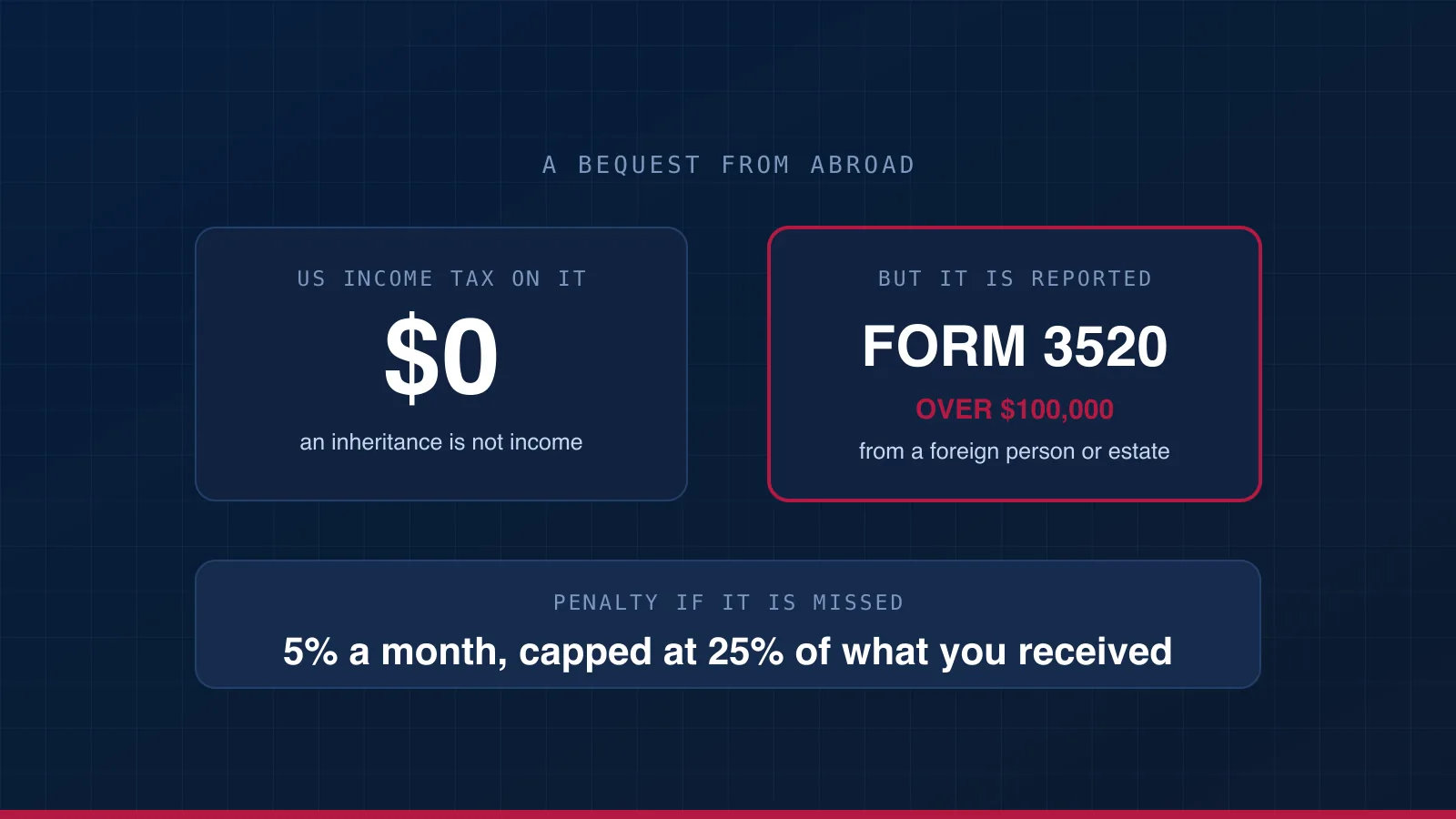
No. An inheritance is not income, and the United States does not tax the person who receives one. The expensive part of a foreign inheritance is never the tax — it is the reporting. Over $100,000 it goes on Form 3520, the penalty for missing that is 5% a month to a cap of 25% of what you received, and the accounts and property that arrive with it can start an FBAR and a Form 8938 obligation in the same year.

The inheritance itself is not income
Gross income does not include the value of property acquired by gift, bequest, devise or inheritance. That is the whole answer to the question most people are actually asking. A transfer of €400,000 from a parent's estate in Spain is not income on your Form 1040, is not taxed at any rate, and does not become taxable because it crossed a border or arrived in a foreign currency.
The United States has no federal inheritance tax charged on the person who inherits. There is a federal estate tax, but it is a tax on the estate rather than on you, and where the person who died was neither a US citizen nor domiciled in the United States it reaches only assets situated in the United States — with a filing threshold of $60,000 of US-situated assets, reported by the executor on Form 706-NA. A parent who lived abroad their whole life, holding property and accounts abroad, is generally outside it entirely.
So nothing is taxed on receipt. What follows is reporting, and the reporting is not optional.
Form 3520, and the penalty that does the damage
A US person who receives more than $100,000 in a tax year from a nonresident alien individual or a foreign estate has to report it on Form 3520, Part IV. The threshold is an aggregate, not a per-transfer figure, and it counts amounts from anyone you know or have reason to know is related to that person — three siblings sending $45,000 each from the same estate is $135,000, not three amounts under the line.
A separate and much lower threshold applies to amounts from a foreign corporation or a foreign partnership: $20,573 for tax year 2026, up from $20,116 for tax year 2025. That one is indexed each year, and it catches distributions routed through a family company more often than people expect.
Form 3520 is an information return. It reports a receipt that carries no tax, and filing it correctly costs nothing but the filing. Three mechanics are worth holding on to. It is due when your income tax return is due, including extensions — so 15 June for someone living abroad with the automatic extension, and 15 October at the outside, which lines up with the dates on the US expat tax deadlines 2026 page. It is filed separately, posted to the IRS service centre in Ogden, Utah, rather than attached to your 1040. And the penalty under section 6039F is 5% of the unreported amount for each month the failure continues, to a maximum of 25%.
That cap is the point. A quarter of a large inheritance is a very large number, assessed over a form that would have reported no tax. The penalty does not apply where the failure is due to reasonable cause and not wilful neglect, but reasonable cause has to be established, and the cheaper course by a wide margin is filing on time.
Once the assets are yours, a second set of obligations starts
The year you inherit is very often the first year someone crosses a foreign reporting threshold, because the assets arrive all at once. An inherited bank or brokerage account abroad is a foreign financial account in which you now have a financial interest, and the FBAR is required if all of your foreign accounts together exceed $10,000 at any point in the calendar year — a threshold a single inherited account usually clears on its own.
Form 8938 can start in the same year. Living abroad, it begins at $200,000 of specified foreign financial assets on the last day of the year or $300,000 at any time during it, and at $400,000 or $600,000 on a joint return. Inherited foreign accounts and securities count towards those figures; inherited real estate held directly does not. Which forms your particular mix of assets triggers is what the FBAR and FATCA compliance page works through.
One trap deserves naming. Foreign mutual funds and similar pooled investments are usually passive foreign investment companies, and inheriting them brings you inside the PFIC rules and Form 8621, which is a materially more complicated regime than holding the equivalent US fund. It is worth identifying what the portfolio actually contains before deciding to keep it.
Basis is the number that decides the tax years later
Your basis in inherited property is generally its fair market value on the date of death. This is the provision that makes the eventual sale bearable, and it applies to foreign property inherited from a foreign person even though that property was never part of a US taxable estate — the step-up comes from the inheritance itself, not from inclusion in anyone's gross estate.
For an expat there is a currency layer on top. Basis is a dollar figure, so the date-of-death value has to be translated at the exchange rate on that date. Sell the property later and the proceeds are translated at the rate on the day of sale, which means currency movement between the two dates can create a dollar gain on a property that did not rise in local-currency terms at all. That arithmetic, and what it does to a sale, is the subject of US tax on foreign property.
The practical consequence is documentary rather than technical: get a dated, supportable valuation at the time of death and keep the exchange rate for that date. Reconstructing both a decade later, in a country whose records you cannot easily obtain, is where the cost of a sale is usually decided.
Inherited PFIC shares are the exception to watch. The statute reduces the stepped-up basis for shares in a section 1291 fund, but that reduction does not apply where the person who died was a nonresident alien throughout the period they held the shares — which is the ordinary case when a foreign parent leaves foreign funds to a US child.
Income after you inherit is taxed normally
The exclusion covers the transfer, not what the assets do afterwards. Interest the inherited account pays, dividends the inherited portfolio throws off, rent from the inherited flat and gain on its eventual sale are all ordinary taxable income from the moment the assets are yours, reported in dollars, with foreign tax on them usually creditable on Form 1116. An inherited property that is rented out is a foreign rental like any other, with the same depreciation and currency rules.
A worked example, tax year 2026
One US citizen living in Europe inherits a flat and a bank account from a parent who was never a US person. The euro is assumed to cost $1.12 on the date of death. Column A reports on time; column B files Form 3520 five months late, which reaches the cap.
Scroll the table sideways
IRC §102(a), §1014(a)(1) and (b)(1), §1291(e), §6039F and §2101; IRS Form 3520 instructions, Part IV, for the thresholds, the due date and the 5% monthly penalty capped at 25%; IRS guidance on gifts from a foreign person for the aggregation rule, the Ogden filing address and the June 15 date for filers abroad; Rev. Proc. 2025-32 for the $20,573 section 6039F threshold for 2026; IRS Form 706-NA instructions for the $60,000 US-situated assets threshold; the IRS Form 8938 and FBAR comparison for the reporting thresholds. Figures are stated for tax year 2026. Checked 7 October 2026.
Questions about inheriting from abroad
Do I pay US tax on money I inherit from abroad?
Not on the inheritance itself. Property acquired by bequest, devise or inheritance is excluded from gross income, so the amount you receive is not taxed as income no matter how large it is or which country it came from. What is taxable is the income the assets produce after they are yours.
When do I have to file Form 3520 for an inheritance?
When the total received from a nonresident alien individual or a foreign estate is more than $100,000 in the tax year, counting gifts and bequests from people you know or have reason to know are related to them. The threshold is far lower for amounts from a foreign corporation or partnership: $20,573 for tax year 2026.
What happens if I miss the Form 3520 deadline?
The penalty is 5% of the unreported amount for each month the failure continues, capped at 25%. On a $728,000 bequest that is $182,000 at the cap, for a form that reports a receipt carrying no tax at all. The penalty does not apply where there is reasonable cause, but that has to be established rather than assumed.
Does inheriting a foreign bank account mean I now file an FBAR?
Usually yes. Once the account is yours you have a financial interest in it, and the FBAR is required if all your foreign accounts together exceed $10,000 at any point in the calendar year. An inherited account often pushes someone over that line for the first time, and Form 8938 may start too.
What is my basis in inherited foreign property if I sell it?
Generally the fair market value on the date of death, translated into US dollars at the exchange rate on that date. That step-up applies even though the property was never part of a US taxable estate. Getting a dated valuation at the time, rather than reconstructing one years later, is what makes it defensible.
Inherited something abroad this year?
Fifteen minutes, free, with me rather than a salesperson — enough to say whether Form 3520 applies to you and what else starts in the same year.