Late FBAR? How to write a reasonable cause statement
Until July 2026, a late FBAR filed with a short explanation came with a published IRS promise of no penalty. That procedure is gone. If your tax returns are complete and only the FBARs are missing, the late reports now go in with a reasonable cause statement, and that statement is what the IRS weighs. Here is what it has to show, an example, and the mistakes that weaken it.
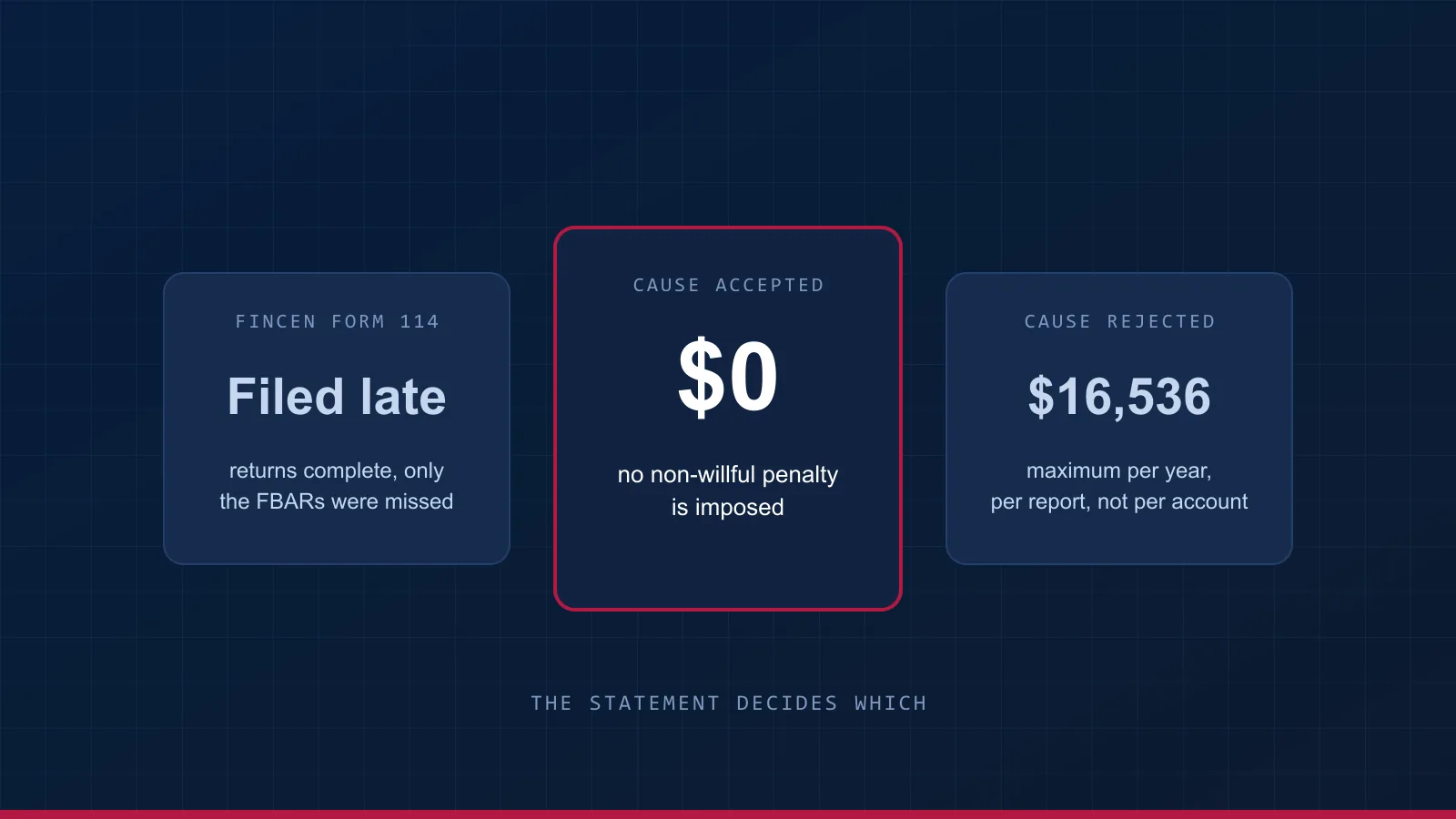

First, check this is your route
A reasonable cause statement fits one situation: your US tax returns for the years in question are filed, they include the income your foreign accounts earned, and what you missed is the FBAR itself. A teacher whose salary went into a local bank account, who filed a 1040 every year but never knew about FinCEN Form 114, is the typical case.
If the returns are also missing, or left out interest, dividends or gains from those accounts, a statement on its own is the wrong tool. The late FBARs belong inside a Streamlined submission, which handles the returns and FBARs together and, if the miss was non-willful, waives the FBAR penalties outright. The Streamlined eligibility article sets out who qualifies. And if the IRS has already written to you about these years, do not file anything yet. Speak to a tax attorney first.
What the statement has to show
FBAR penalties are discretionary. For a non-willful violation, the law says no penalty is imposed if the failure was due to reasonable cause and the account balance is properly reported. Reasonable cause, in the IRS's usual test, means you exercised ordinary care and prudence and still failed to comply. The statement is your evidence for that, and it is read alongside your returns, so the two have to agree.
A strong statement covers five things, in this order.
| Part | What to state | Why it matters |
|---|---|---|
| The accounts | Which accounts, where, when opened, and what they were for | Ordinary local accounts for salary or bills read very differently from accounts opened to hold money out of view |
| Why you missed it | The specific reason, in your own words | A concrete reason is a fact; a vague one is an excuse |
| The income was reported | That the accounts' income was on your US returns, and any foreign tax paid on it | No US tax was lost, which goes to good faith and to the second half of the legal test |
| When you found out | The date you learned of the requirement, and how | Shows the failure ended when your ignorance did |
| What you did next | That you filed every missing year promptly, and will file on time from now on | Prompt correction is one of the strongest signs of good faith |
An example
This is an illustration, not a template to copy. Your statement has to describe your own facts, and the details below are invented.
I am a US citizen and have taught at an international school in Dubai since August 2020. On arrival I opened a current account and a savings account with a UAE bank, because the school pays salaries only into a local account. I used them for my salary and living costs. Their combined balance first exceeded $10,000 in 2020.
I filed a US return for every year from 2020 to 2025 through a US tax software package, reporting my salary and the interest the savings account paid. Neither the software nor the school told me about a separate report for foreign accounts, and I did not know one existed.
I learned of the FBAR requirement in September 2026 from a colleague, and engaged an Enrolled Agent the same month. The FBARs for 2020 to 2025 were filed on 20 October 2026. I will file every future FBAR on time.
My failure to file was not willful. I did not know of the requirement, the accounts held my local salary, and their income was reported on my US returns throughout.
It works because every sentence is a checkable fact, and the facts line up: an ordinary purpose for the accounts, income already reported, a dated discovery and a prompt fix. It does not argue, apologise at length or quote the law.
What weakens a statement
"I didn't know" and nothing else. Not knowing is the most common reason and can be a good one, but on its own it says nothing about care. Surround it with the facts that make it believable.
Facts your returns contradict. If the statement says the account only held your salary but a return shows large investment income from it, the statement fails on the first read. Check every claim against the returns before you file.
Blaming an adviser without the detail. Relying on a professional can be reasonable cause, but only if you gave them the full picture. "My accountant never mentioned it" is stronger with "I gave them my foreign bank statements every year".
Waiting. Each month between finding out and filing works against you. Filing after the IRS has contacted you changes the conversation altogether.
Saying more than you can support. The statement is signed and can be checked. Overstating your case is worse than a plain, accurate account.
How to file the late FBARs
Each year is a separate FinCEN Form 114, filed electronically through FinCEN's BSA E-Filing System. Filing is free. File the last six years, the period in which the IRS can assess an FBAR penalty, using the highest balance of each account in each year, converted at the Treasury year-end rate.
The form's first page asks why the report is late. Choose the listed reason that fits; if none does, choose Other and give the short version of your explanation in the box it opens. The text box is brief, so keep the full statement, signed and dated, with your records. If the IRS asks why the reports were late, that is what you send.
Under Bittner v. United States, the non-willful penalty applies per report, not per account. Five accounts on one year's FBAR are one exposure of up to $16,536, not five. That still means six late years carry six exposures, which is why the statement is worth writing well.
What it costs here
FBAR-Only Filing is $125 for up to five accounts, plus $45 for each further five. The statement is drafted with you, from your facts, as part of the work. If on the free call it turns out your returns need fixing too, you will hear that before you pay for anything, and the catch-up filing guide explains what that route involves. If your case is simple and you would rather file yourself, the FBAR and FATCA page says when that is the sensible choice.
31 U.S.C. §5321(a)(5) on FBAR civil penalties and the reasonable cause exception, and §5321(b)(1) on the six-year assessment period; 31 CFR 1010.350; FinCEN Form 114 and the BSA E-Filing System; Bittner v. United States, 598 U.S. 85 (2023); IRS Internal Revenue Manual 4.26.16 on FBAR penalties; the IRS's withdrawal of the Delinquent FBAR Submission Procedures in July 2026. Checked 6 November 2026.
Questions about late FBARs
What is a reasonable cause statement for a late FBAR?
A short, factual explanation of why an FBAR was not filed on time, filed with the late report. FBAR penalties are discretionary, and the law says no non-willful penalty is imposed when the failure was due to reasonable cause and the account balance is properly reported. The statement is how you show that.
Where does the statement go when I file the late FBAR?
The FBAR is filed electronically through FinCEN's BSA E-Filing System. Its first page asks why the report is late: choose the listed reason that fits, or Other, which opens a short text box for your explanation. Keep a fuller signed statement with your records in case the IRS asks for it.
How many years of late FBARs should I file?
Usually the last six, because the IRS has six years to assess an FBAR penalty. Each year is its own report, and each report carries its own exposure: up to $16,536 per year for a non-willful violation, however many accounts that year's report lists.
Is "I did not know I had to file" reasonable cause?
On its own, it is weak. It becomes stronger with the facts around it: the accounts were ordinary local accounts in the country you live in, the income from them was on your US returns, no adviser told you, and you filed promptly once you found out.
When is a reasonable cause statement the wrong route?
When your US returns are also missing or left out income from the accounts. Then the late FBARs belong inside a Streamlined submission, which covers the returns and FBARs together and waives the FBAR penalties if the miss was non-willful. And if the IRS has already contacted you, speak to a tax attorney before filing anything.
Missed some FBARs?
Fifteen minutes with the Enrolled Agent who would file them. You will know whether a statement is enough, or whether the returns need fixing too.