FBAR vs FATCA: what each one requires
They sound like one rule and they are two. The FBAR is filed with the Treasury once your foreign accounts together pass $10,000. FATCA reporting, Form 8938, travels with your tax return at higher thresholds. Many Americans abroad owe the first and not the second, some owe both, and filing one never covers the other. Here is how they compare and how to tell which you owe.
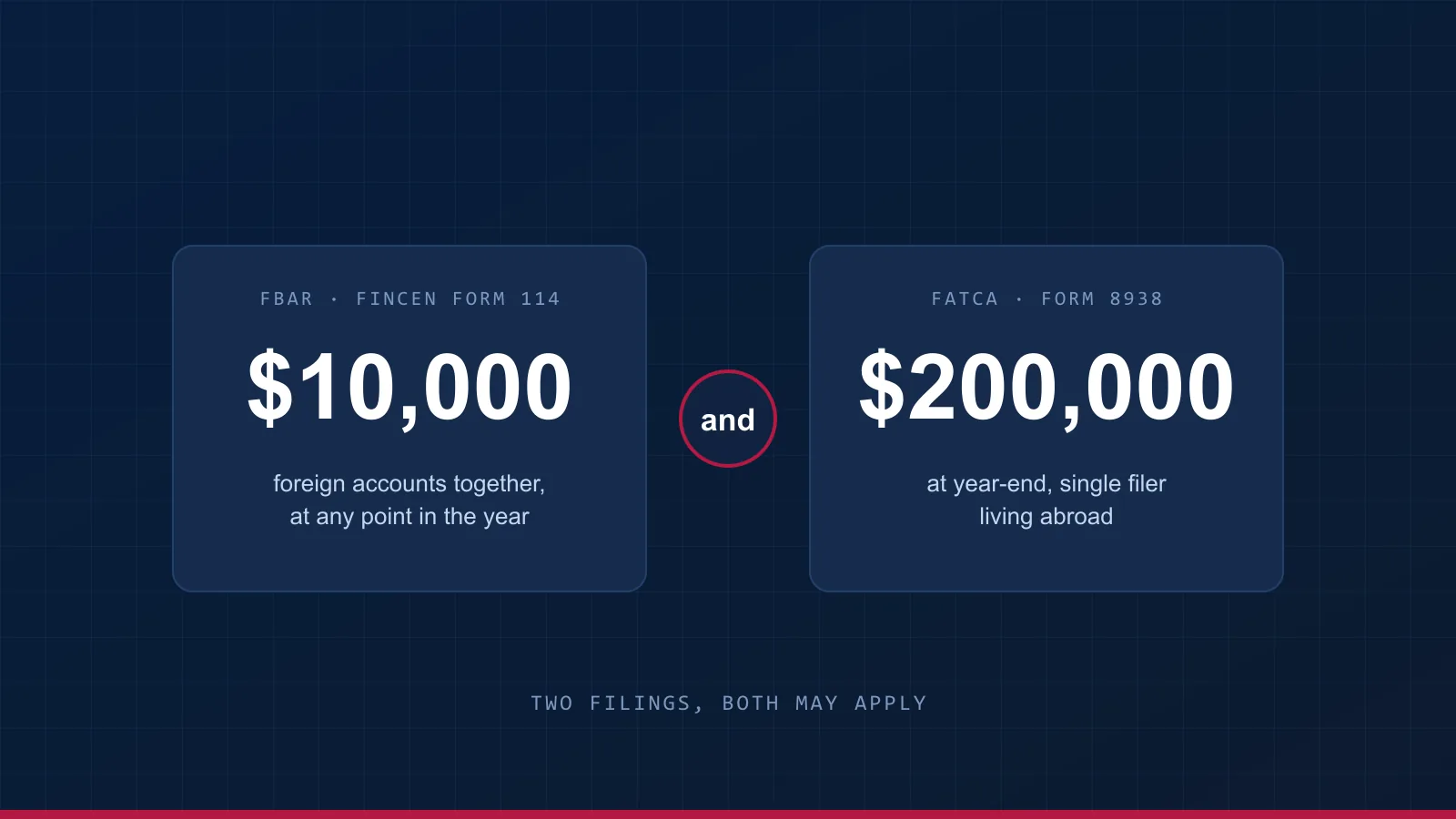

Side by side
| FBAR | FATCA | |
|---|---|---|
| Form | FinCEN Form 114 | IRS Form 8938 |
| Filed with | FinCEN, electronically through BSA E-Filing, free | The IRS, attached to your tax return |
| Triggered when | Foreign financial accounts together pass $10,000 at any point in the year | Specified foreign financial assets pass the threshold for your situation, below |
| What it covers | Foreign financial accounts you own, and those you only have signature authority over | Foreign accounts, plus assets held outside accounts such as shares in a foreign company or an interest in a foreign entity |
| Due | 15 April, extended automatically to 15 October with no request | With your return, including any extension |
| Penalty for not filing | Up to $16,536 per report for a non-willful violation | $10,000, with more if you continue after IRS notice |
The Form 8938 thresholds
Form 8938 thresholds depend on whether you live abroad, which for this purpose means you are a bona fide resident of a foreign country or you spend at least 330 full days abroad in a 12-month period, and on your filing status. You file if you are over either figure.
| Filing status | Living abroad: year-end or any time | Living in the US: year-end or any time |
|---|---|---|
| Single | $200,000 or $300,000 | $50,000 or $75,000 |
| Married filing jointly | $400,000 or $600,000 | $100,000 or $150,000 |
Form 8938 follows the tax return. If you are not required to file an income tax return, you do not file Form 8938 either, which is not true of the FBAR. Whether you need a return is covered in do you have to file from abroad.
Two examples
$60,000 in two local accounts, single, living abroad. The FBAR is required, because the accounts together passed $10,000. Form 8938 is not, because $60,000 is far below $200,000. One filing.
$250,000 in local accounts and shares in a foreign company, single, living abroad. The FBAR is required for the accounts. Form 8938 is required too, because the total passed $200,000 at year-end, and it includes the shares, which an FBAR does not report. Two filings, reporting overlapping assets in different places.
One does not replace the other
The two filings go to different agencies, under different laws. Listing an account on Form 8938 does not satisfy the FBAR, and the reverse is also true. A Form 8938 that is attached to the return is not an FBAR on file with FinCEN. This is the mistake that costs people most: they file a return with Form 8938 and assume the foreign accounts are dealt with.
If you have missed one
A missed FBAR on its own, with returns complete, can now be filed late with a reasonable cause statement. The old Delinquent FBAR procedures ended in July 2026, as the article on their withdrawal explains. If returns are also missing, the Streamlined procedures handle the returns, the FBARs and Form 8938 together.
What it costs here
FBAR-Only Filing is $125 for up to five accounts, plus $45 for each further five. Form 8938 is included in the Complete Return at $599. The forms checker shows which of these apply to you before you spend anything, and the FBAR and FATCA page says when filing the FBAR yourself is the sensible choice.
31 U.S.C. §5314 and §5321 and 31 CFR 1010.350 on the FBAR; FinCEN Form 114 and the BSA E-Filing System; IRC §6038D and the IRS Form 8938 instructions on thresholds, the abroad test and penalties; IRS, Comparison of Form 8938 and FBAR requirements; IRS, US citizens and resident aliens abroad: filing requirements (updated 28 September 2026). Checked 8 November 2026.
Questions about FBAR and FATCA
What is the difference between FBAR and FATCA?
The FBAR is FinCEN Form 114, filed electronically with the Treasury's FinCEN once your foreign financial accounts together pass $10,000 at any point in the year. FATCA reporting is Form 8938, attached to your tax return, with higher thresholds. They overlap in what they cover but are separate filings.
If I file Form 8938, do I still need the FBAR?
Yes, if the FBAR threshold is met. Form 8938 goes to the IRS with your return and the FBAR goes to FinCEN. Reporting an account on one does not satisfy the other.
Can I need an FBAR but not Form 8938?
Yes, and it is the common case. A single filer living abroad with $60,000 across two local accounts files an FBAR, because the total passed $10,000, but is well under the Form 8938 threshold of $200,000 at year-end.
Do I owe tax because I file these?
No. Both are information reports. They tell the government what you hold abroad. Tax on the income those assets earn is reported on your return in the usual way.
What happens if I miss one?
A non-willful FBAR violation can carry a penalty of up to $16,536 per report, and willful violations carry far more. Failing to file Form 8938 carries a $10,000 penalty, with further penalties if you continue after the IRS notifies you. Reasonable cause can reduce or remove penalties in each case.
Not sure which one you owe?
Fifteen minutes with the Enrolled Agent who would file them. You will know which reports apply before you pay for anything.