Do you have to file a US tax return from abroad?
Almost always, if you earn a living. The United States taxes citizens and green card holders on income from anywhere in the world, so moving abroad changes where you file from, not whether you file. There is a threshold below which you do not need to, and a self-employment rule that overrides it. Here are both, the deadlines that apply from abroad, and what to do if you have missed years.

The income test
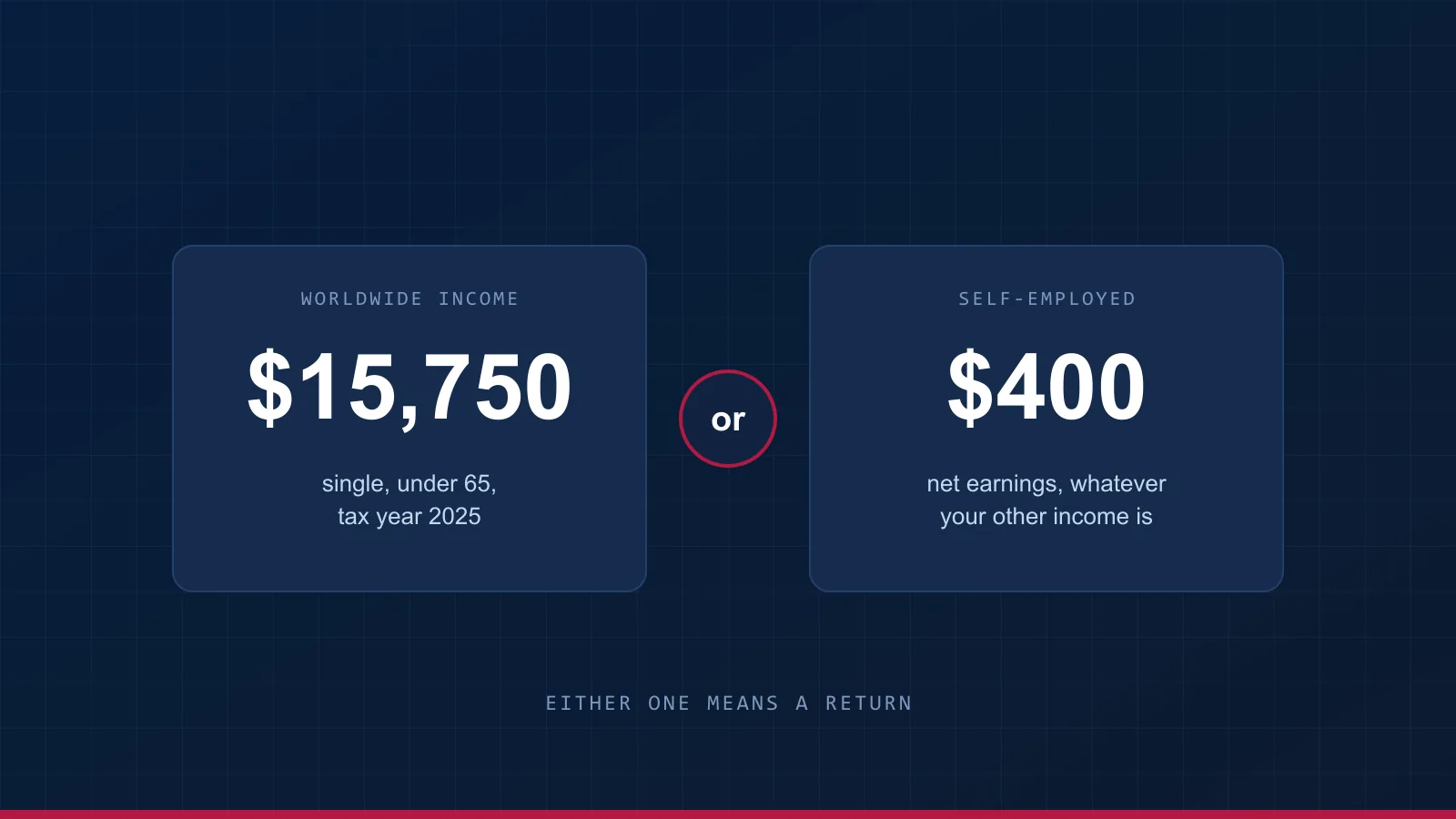
The IRS says you usually must file if your gross income from worldwide sources is at least the amount for your filing status. For tax year 2025 those amounts, for filers under 65, are below. They are the same as the standard deduction for each status, except for married filing separately, where the threshold is only $5.
| Filing status | 2025 gross income threshold, under 65 |
|---|---|
| Single | $15,750 |
| Head of household | $23,625 |
| Married filing jointly, both spouses | $31,500 |
| Married filing separately, any age | $5 |
The thresholds are higher for filers aged 65 or over. Gross income counts all of your income from anywhere, including foreign salary, so a job in another country puts most people over the line quickly.
The self-employment rule
If your net earnings from self-employment are $400 or more, you must file a return even when your total income is below the thresholds above. A freelancer abroad earning $6,000 in a year is therefore filing, and also owes self-employment tax unless a totalization agreement says otherwise. The self-employment tax estimator shows what that comes to for your country.
Owing nothing is not the same as not filing
Many people abroad assume that paying tax in their host country, or earning less than the exclusion amount, ends the US obligation. It does not. The relief is claimed on the return. The Foreign Earned Income Exclusion is elected by attaching Form 2555 to a filed return, and the foreign tax credit is claimed on Form 1116. Without a return, neither exists, and the IRS has nothing on record to show you owe nothing.
That is why a salary that is fully excluded still leaves a return to file. If you are comparing the two reliefs, the exclusion against the credit is the next thing to read.
The deadlines that apply from abroad
15 April. The regular due date, and the date interest starts on any tax you owe.
15 June. An automatic two-month extension if you live outside the United States and your main place of business or post of duty is outside it on the regular due date. You do not apply. You attach a statement to the return explaining that you qualify.
15 October. A further extension, requested on Form 4868 by 15 June, with the box on line 8 ticked to show you are out of the country. I file Form 4868 for clients at no charge. Neither the June nor the October extension extends the time to pay: interest runs on any unpaid tax from 15 April.
For tax year 2025 the extended deadline was 15 October 2026 and has passed. For tax year 2026 the dates are 15 April, 15 June and 15 October 2027.
If you have not been filing
Americans abroad miss returns for years, and in my experience the usual reason is that nobody told them. Before you file the missing years one by one, check whether the Streamlined Foreign Offshore Procedures fit. They cover the last three years of returns and six years of FBARs together, and waive the penalties for people who qualify. The eligibility article and the catch-up filing guide set out who does, and the Streamlined decision tree works through it for you.
Two other reports travel separately
The FBAR (FinCEN Form 114) is filed with the Treasury, not with your tax return, once your foreign accounts together pass $10,000. Form 8938 attaches to the return at higher thresholds. Whether you must file an income tax return and whether you must file either report are separate questions. FBAR against FATCA explains the difference, and the forms checker tells you which apply to you.
What it costs here
The Complete Return is $599 flat: federal, one state, FBAR, FATCA, the choice between the exclusion and the credit, the housing exclusion and treaty positions. The pricing page lists every other price, including the Essential Return at $449 for simpler cases. If you are not sure whether you are required to file, the free 15-minute call settles that before you pay anything.
IRS, US citizens and resident aliens abroad: filing requirements (page updated 28 September 2026); IRS Publication 54, Tax Guide for U.S. Citizens and Resident Aliens Abroad (December 2025), on the automatic two-month extension, Form 4868 and the $400 self-employment rule; IRS Publication 501 (2025), Table 1, for the 2025 gross income thresholds, which match the 2025 standard deductions in IR-2025-103. Checked 8 November 2026.
Questions about filing from abroad
Do I have to file a US tax return if I live abroad?
Usually, yes. A US citizen or resident alien files if gross income from worldwide sources reaches the threshold for their filing status. For 2025 that is $15,750 for a single filer under 65 and $31,500 for a married couple filing jointly, both under 65. Net self-employment earnings of $400 or more also require a return, whatever the rest of your income is.
Do I still file if I pay no US tax?
Yes. The threshold is about how much you earned, not how much you owe. The Foreign Earned Income Exclusion and the foreign tax credit are both claimed on a filed return, so the return is what brings the US tax down, often to nothing.
What if I earn less than the threshold?
Then you generally do not have to file an income tax return, unless you were self-employed and your net earnings reached $400. The FBAR is separate and has its own $10,000 threshold, so check it even in a year when no return is required.
Do green card holders abroad have to file?
Yes. The IRS requirement covers US citizens and resident aliens, and a green card holder is a resident alien for tax purposes for as long as they hold the card, wherever they live.
Is the 15 June deadline automatic?
If you live outside the United States and your main place of business or post of duty is outside it on the regular due date, you get an automatic two months, to 15 June. You do not apply. You attach a statement to the return saying you qualify. Interest on any tax owed still runs from 15 April.
What if I have not filed for several years?
Do not file the missing years one at a time before checking the options. If the miss was non-willful and no examination is open, the Streamlined Foreign Offshore Procedures may cover the returns and the FBARs together, with penalties waived for filers who qualify.
Not sure you have to file?
Fifteen minutes with the Enrolled Agent who would prepare and sign your return. You will know where you stand before you pay for anything.