FEIE or foreign tax credit: which is better for you?
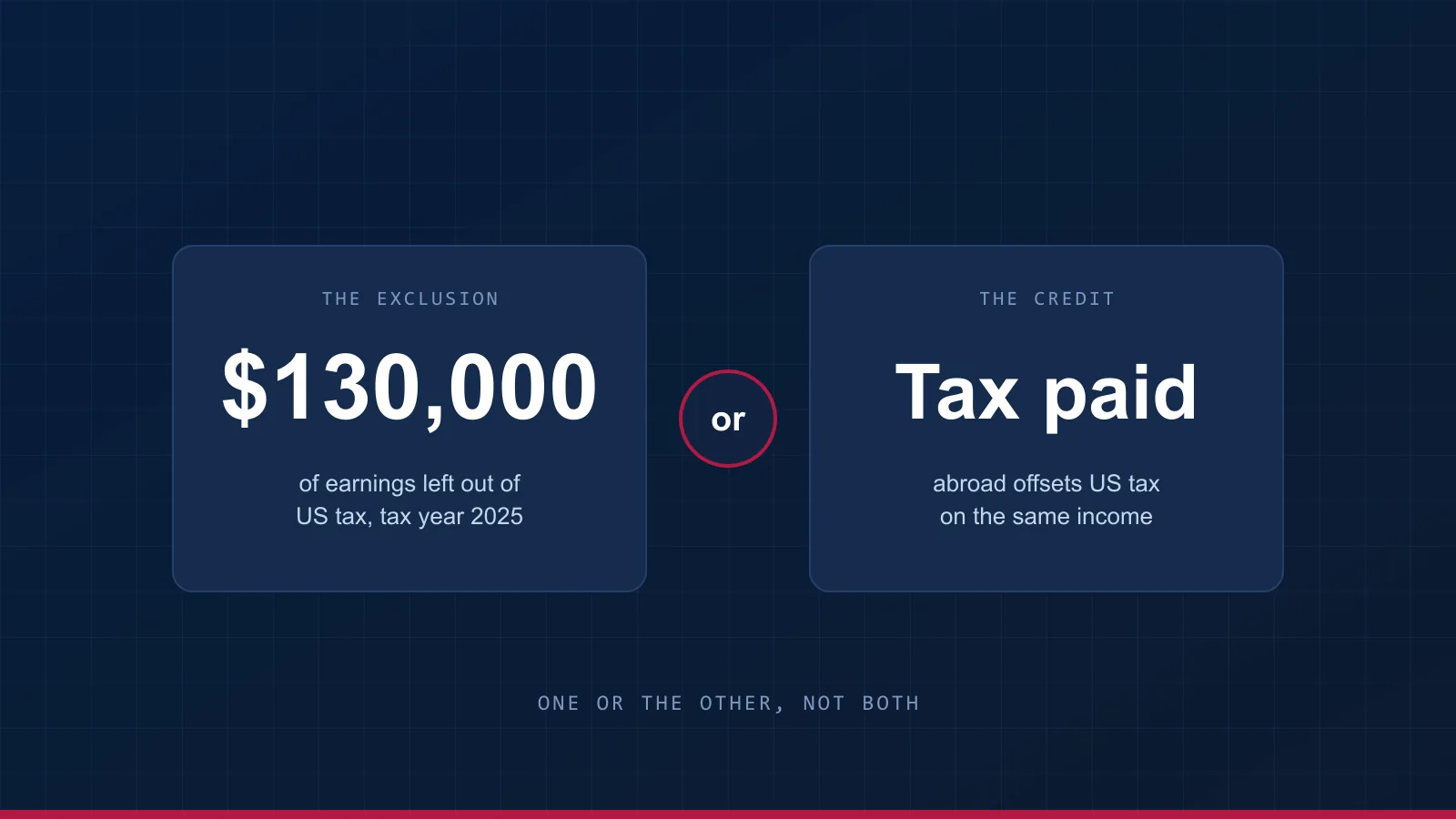
Two rules stop an American abroad being taxed twice on the same salary. The Foreign Earned Income Exclusion leaves the earnings out of US tax. The foreign tax credit counts them, then lets the tax you paid abroad offset the US bill. You cannot use both on the same income, and the choice is harder to undo than most people expect. Here is how they differ and how to choose.

What each one does
Both are claimed on a filed return, and neither applies unless you file. The exclusion is limited by an amount; the credit is limited by the US tax on your foreign income.
| Exclusion (Form 2555) | Credit (Form 1116) | |
|---|---|---|
| What it does | Leaves up to $130,000 of foreign earned income out of US income tax for 2025, $132,900 for 2026 | Reduces US tax by the foreign income tax you paid or accrued, up to the US tax on that foreign income |
| What you must show | 330 full days abroad in any 12 consecutive months, or bona fide residence abroad for an uninterrupted period that includes a whole tax year | That you actually paid or accrued foreign income tax |
| If there is more than the limit | The excess is taxed in the US | Foreign tax above the limit can be carried back 1 year or forward 10 years |
| Self-employment tax | Not reduced | Not reduced |
They cannot cover the same income
The IRS is explicit: if you exclude foreign earned income, you cannot take a foreign tax credit for the tax on that income. More broadly, Publication 54 says you cannot deduct, exclude or take a credit for any item related to amounts you exclude. So for your salary, it is one or the other.
You can mix them across different income. A person who excludes their salary can still claim the credit for foreign tax on interest, dividends or rent, because that income was not excluded.
When the exclusion usually wins
When your host country charges little or no income tax, there is nothing to credit, so the exclusion is the only relief available. Americans working in the UAE and the other Gulf states are the standard example. If your earnings are also under the limit, the exclusion can take your US income tax on that salary to nothing.
When the credit usually wins
When your host country taxes your salary at rates close to or above US rates, the credit can bring the US tax on that income to nothing without using the exclusion, and any foreign tax beyond that carries to other years. It also wins for earnings above the exclusion limit, where the exclusion would leave the excess taxed.
The credit leaves your income in the return, while the exclusion takes it out, and other rules that look at your earned income see the difference. That matters most if you contribute to an IRA, which the article on IRA contributions abroad explains.
Neither one touches self-employment tax
The IRS says the excluded amount reduces regular income tax but not self-employment tax. The credit is against income tax, so it does not reduce it either. If you work for yourself abroad, the thing that can change self-employment tax is a totalization agreement. The self-employment tax estimator shows what applies in your country.
The catch: switching back
You can stop claiming the exclusion by attaching a statement to the return for the first year you want to stop. The foreign earned income exclusion and the housing exclusion are revoked separately. But if you later want the same exclusion again within five tax years, you must apply to the IRS for approval, by requesting a ruling, and the IRS charges a fee for it.
So a year in which you elect the exclusion out of habit, when the credit would have served you better, can close the exclusion to you later if you move somewhere with no income tax. This is a choice to make on the numbers, not by default. The six ways to reduce US tax abroad puts it in the context of the other levers.
How to decide
1. Find out what you pay locally. The income tax your host country charges on your salary is the biggest single factor.
2. Check you pass a test. The exclusion needs 330 full days abroad or bona fide residence. The credit does not.
3. Look ahead. If you may move to a lower-tax country, keep the exclusion available rather than using it where the credit would have done the job.
4. Run it both ways. For many returns the difference is visible only when both are computed. Choosing between them is part of the Complete Return at $599, and the free 15-minute call is a fair place to ask which way your case leans.
IRS, Foreign Earned Income Exclusion (updated 12 June 2026), on the two tests and on self-employment tax; IRS, Foreign Tax Credit (updated 9 July 2026), on Form 1116 and the bar on crediting tax on excluded income; IRS, Revoking your choice to exclude foreign earned income (updated 14 March 2026), on revocation and the five-tax-year rule; IRS Publications 54 and 514; IR-2024-273 and IR-2025-103 for the 2025 and 2026 exclusion amounts. Checked 8 November 2026.
Questions about the exclusion and the credit
Can I claim the exclusion and the foreign tax credit together?
Not on the same income. The IRS says a foreign tax credit may not be claimed for taxes on income you exclude. You can exclude your foreign salary and still claim the credit for foreign tax on other income, such as interest or rent, that you did not exclude.
Is the Foreign Earned Income Exclusion automatic?
No. You elect it by attaching Form 2555 to a filed return, and you must pass either the physical presence test or the bona fide residence test. If you do not claim it, the income is taxed as ordinary income and any relief comes from the credit.
What is the exclusion limit for 2026?
$132,900 for tax year 2026, up from $130,000 for tax year 2025. The 2026 figure applies to returns filed in 2027.
Can I switch from the exclusion to the credit?
Yes, by attaching a statement to the return for the first year you want to stop claiming it. The catch is that if you want the exclusion again within five tax years, you must ask the IRS for approval through a ruling request, and the IRS charges a fee for it.
Does either one reduce self-employment tax?
No. The IRS states that the excluded amount reduces regular income tax but not self-employment tax, and the foreign tax credit offsets income tax only. What can change self-employment tax is a totalization agreement between the US and the country you work in.
Exclusion or credit?
Fifteen minutes with the Enrolled Agent who would prepare your return. Bring your country and your salary, and you will hear which way your case leans.