US tax for Americans in El Salvador
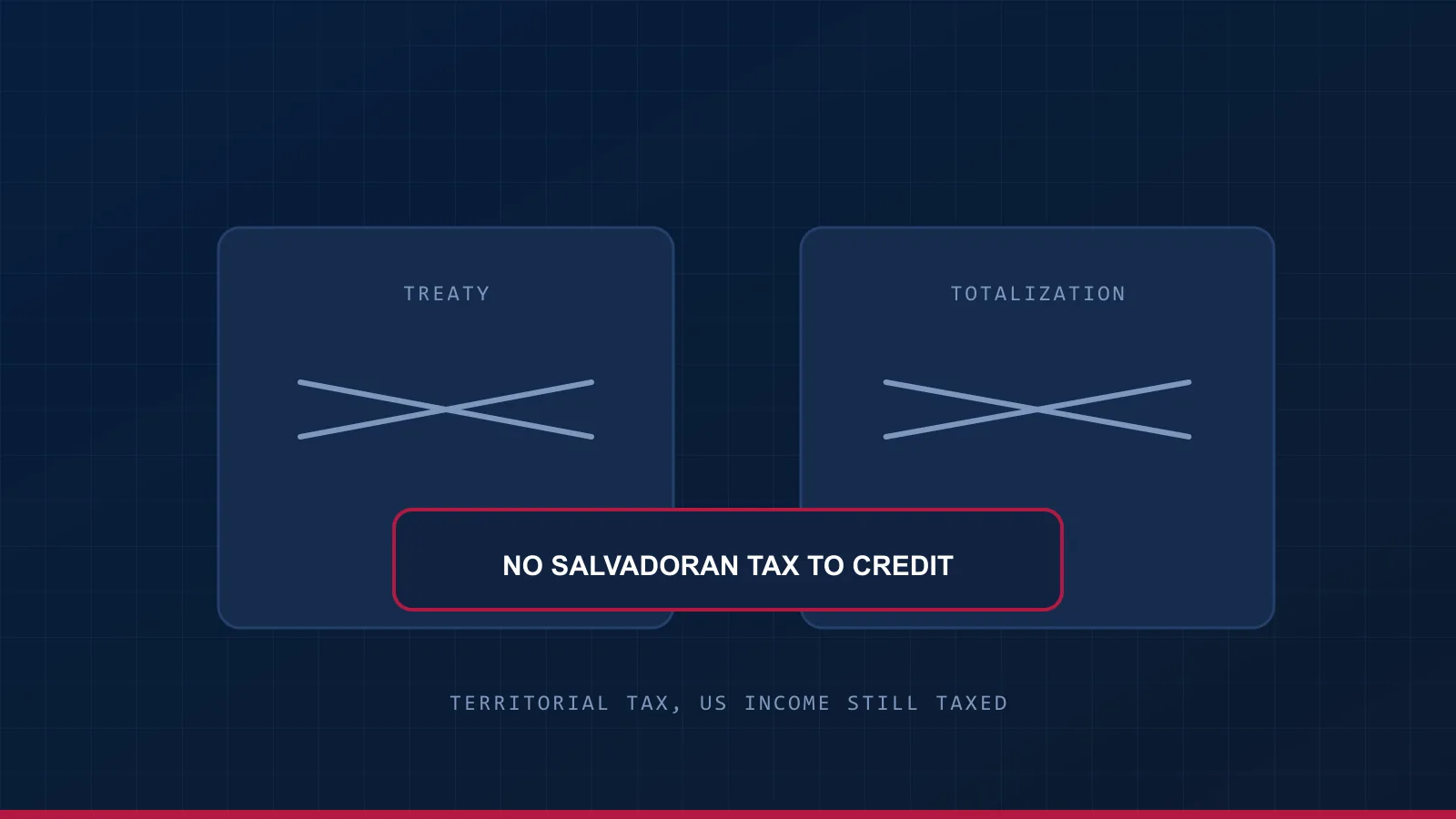
I am from El Salvador, and I prepare US returns for Americans abroad. There is no US–El Salvador income tax treaty and no totalization agreement, and El Salvador taxes only Salvadoran-source income. The two tax systems do not cancel each other out. The US counts everything, wherever you live, and that is what this guide explains.

Why I wrote this one differently
Most guides to US taxes abroad are written from the outside, and they treat a country as a list of rules. I would rather explain it the way I would to someone from home, starting with the thing people least expect: what El Salvador does about tax and what the IRS does about tax have nothing to do with each other.
Two systems, both true at once
Since a March 2024 reform, El Salvador leaves income from foreign sources, such as dividends, interest and capital gains from assets abroad, out of its income tax. It taxes Salvadoran-source income: wages from a Salvadoran employer, local clients, rent from property there. Tax residence there turns on more than 200 consecutive days in a calendar year, or on El Salvador being your main source of income.
The US does the opposite. It taxes its citizens on everything they earn anywhere, and it does so whether or not they live in the US. Because there is no treaty, nothing sits between the two systems: no tie-breaker if they disagree and no article that gives one country priority.
So when El Salvador takes no tax on your income, the US does not follow. It means there is no foreign tax for you to credit, and the Foreign Earned Income Exclusion, which covers earned income only, is the relief you are left with.
If you were born in El Salvador and became a US citizen
Nothing about being born there changes your US filing duty. A naturalized citizen files every year on worldwide income, and Salvadoran nationality makes no difference. A common assumption is that living in El Salvador means filing in El Salvador and nowhere else. It does not work that way for a US citizen, and nobody should feel they failed because no one told them.
If you have gone years without filing, that can often be fixed. If the miss was non-willful, the Streamlined procedures waive the penalties. Whether you qualify depends on three conditions, which the article on who qualifies for the Streamlined filing procedures sets out, and the catch-up filing guide covers the process.
If you hold a green card and came back
A green card holder is a US tax resident until the card is formally given up. Moving away does not end it. The card has to be surrendered, and if you have held it in eight of the last fifteen years, giving it up brings expatriation tax filings on Form 8854. I refer that work out, but I would rather you know about it before you act than after.
Dollars, bitcoin and the FBAR
El Salvador uses the US dollar, so a Salvadoran bank balance reaches the FBAR with no currency conversion. If your foreign accounts together passed $10,000 at any point in the year, you file one whether or not you owe tax. The FBAR and FATCA page explains when the review is worth paying for.
Bitcoin is a different question. The IRS treats digital assets as property, so selling, swapping or spending it is a taxable event measured in dollars, and the digital-asset question on Form 1040 has to be answered. Whether a crypto account also counts for the FBAR or Form 8938 depends on where and how it is held. Do not assume it does not.
Money moving between family
Gifts are reportable even when they are not taxable. Gifts you receive from a foreign person are reported on Form 3520 once the total passes $100,000 in a year, with a penalty for missing it, and gifts you make above the annual exclusion need a Form 709. The article on foreign inheritances covers the same reporting rule in more detail.
Contributions to the Salvadoran social security and pension system, the ISSS and the AFPs, are not income tax, so they are not creditable. With no totalization agreement they relieve nothing on the self-employment side either, where the 15.3% self-employment tax applies in full.
How each kind of income is treated
The same US citizen can have several kinds of income at once, and each lands differently. This is the table I would sketch for someone sitting across from me.
Scroll the table sideways
Scroll the table sideways
IRS list of US income tax treaties and IRS Publication 901; Social Security Administration list of totalization agreements; IRS Publication 54; IRS Notice 2014-21 and IRS digital assets guidance; IRC §877A; Forms 3520, 709 and 8938 instructions; EY Global Tax Alert 2024-0695 on the March 2024 reform; PwC Worldwide Tax Summaries for El Salvador on tax residence; Rev. Proc. 2025-32; 31 CFR 1010.350. US figures are tax year 2025. Checked 2 November 2026.
Questions Americans in El Salvador ask
I became a US citizen and moved back to El Salvador. Do I still file a US return?
Yes, every year, on your worldwide income, even if you owe nothing and even though you are also Salvadoran. Moving back does not end the filing duty. Formally renouncing citizenship does, and that has its own tax consequences.
Does El Salvador's exemption for foreign income mean I owe the IRS nothing?
No. The exemption is a Salvadoran rule about Salvadoran tax. The US taxes citizens on worldwide income wherever they live, so the practical effect is that there is no foreign tax to credit. The exclusion covers earned income only, so it does not reach dividends, interest or capital gains.
I hold a green card and live in El Salvador. Am I still a US tax resident?
Yes, until the card is formally given up. Spending time abroad does not end it for tax purposes. If you have held the card in eight of the last fifteen years, giving it up also brings expatriation tax filings on Form 8854, which I refer out.
Is my bitcoin taxable in the US?
Yes. The IRS treats digital assets as property, so selling, swapping or spending bitcoin is a taxable event in US dollars, whatever El Salvador's rules say. The digital-asset question on Form 1040 has to be answered, and a crypto account may also count for the FBAR or Form 8938 depending on where and how it is held.
I have not filed for years. Is it too late?
Often not. If the miss was non-willful, the Streamlined Foreign Offshore Procedures waive the failure-to-file, failure-to-pay and FBAR penalties: three years of returns, six years of FBARs, and Form 14653. Whether you qualify depends on your facts, so start with a conversation before filing anything.
Living in El Salvador and unsure what you owe?
Fifteen minutes with the Enrolled Agent who will prepare and sign your return. If you have not filed in years, start here.